
Little Acts of Care – Babies in Brazilian Early Childhood Education
Posted 3rd July 2026
Guest post by Vanessa Neves
The EnlaCEI research group is all about understanding how babies and toddlers develop culturally when they’re in collective care and education settings. Between 2017 and 2019, we followed a group of infants (aged seven to ten months) as they began their journey at a Brazilian Early Childhood Education Centre, EMEI Tupi.
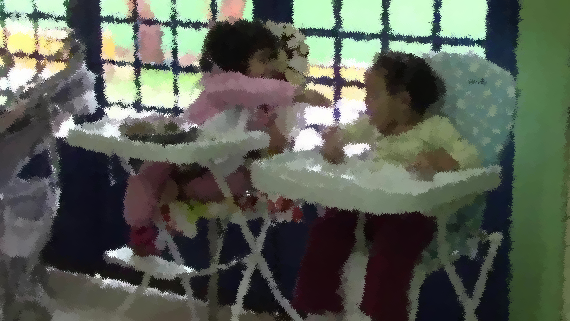
Cosy moment – Maria being fed by Laura (Captured by the EnlaCEI research group)
This particular study zooms in on how babies themselves engage in acts of caring within this centre. Care here isn’t just about feeding or soothing – it’s been thought of in many ways: as social and political (Tronto, 2007; Hirata, 2022), as a cultural practice (Maranhão, 2000), as something that happens in relationships (Noddings, 2013; Katz et al., 2020), and as central to how infants build their subjectivities (Vygotsky, 1983). We take care to mean something biological, cultural, cognitive, and emotional – a way of relating to oneself, to others, and to the environment, always involving attentiveness and responsiveness.
The Study
Using Cultural-historical Psychology and Ethnography in Education, we videotaped everyday life in the nursery back in 2017. With a microgenetic lens, we focused on moments when one infant, Maria, initiated caring acts.
Ethics were front and centre: informed consent was obtained, participants could withdraw at any time, and filming stopped whenever discomfort was noticed. Teachers and families were shown extracts and invited into conversations about the research aims.
What We Saw

Cosy moment – Teacher feeds Maria (Captured by the EnlaCEI research group)*
- Maria copied the caring practices of her teachers.
- She gave them her own twist, re-signifying them through cultural appropriation and her emerging subjectivity.
- She tried to comfort crying peers and even attempted to feed them.
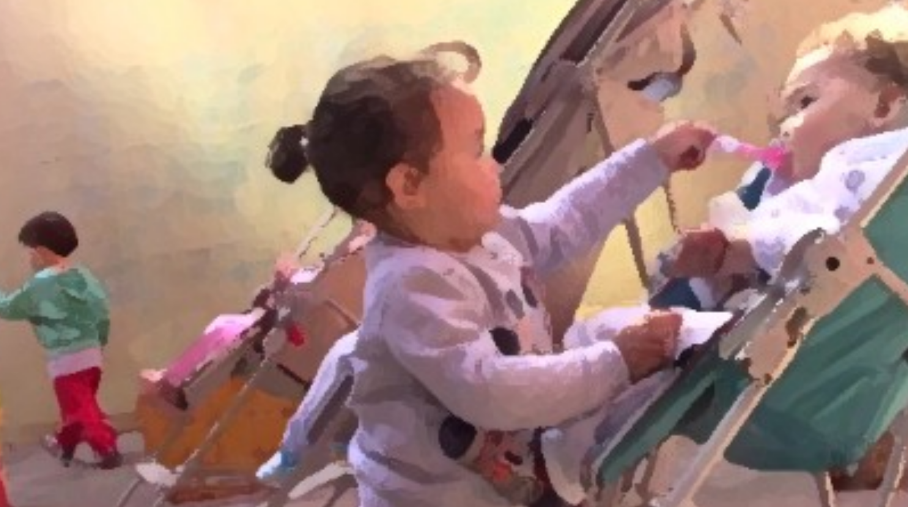
Cosy moment – Teacher feeds Maria (Captured by the EnlaCEI research group)*
Why It Matters
These small but powerful gestures show how teachers’ everyday practices create a culture of care that babies can step into and make their own. It highlights that care is not just something done to infants, but something they actively take part in – shaping their relationships, their sense of self, and their place in the group.
This blog was prepared with the support of Microsoft Copilot, which was used as a language editor.
*All copyrights for the image and related materials are credited to Vanessa Neves.
Research Group Website: https://enlacei.com.br/
References:
HIRATA, H. (2022). O cuidado: teoria e práticas. [Care: theories and practices].
Tronto, J. C. (2013). Caring democracy: Markets, equality, and justice. New York: New York University Press, 2013
MARANHÃO, D. G. (2000). O cuidado como elo entre saúde e educação. [Care as a link between health and education]. Cadernos de Pesquisa, São Paulo, v. 111, p. 115-133.
NODDINGS, Nell. Caring: A relational approach to ethics moral education. California: University of California Press, 2013.
KATZ, L. et al. (2020). Making visible acts of caring among infants & toddlers. Pedagogies (Mahwah, N.J.), p. 1-16.
VYGOTSKI, L. S. (1983). Análisis de las funciones psíquicas superiores. [Analisys of higher mental functions]. In: VIGOTSKI, L. S. Obras Escogidas. Madrid: Aprendizaje-Visor, v. III, p. 97-120.
Further Reading:
Neves, V. F. A., Quiñones, G., & Silva, E. B. T. (2025). Ethics of care involving young children: perspectives from Australia and Brazil. Ethnography and Education, 1–18. https://doi.org/10.1080/17457823.2025.2585267
Neves, V. F. A., Silva, E. B. T., & Oliviera, V. S. (2025). A triangle of curiosity: infants, researchers, and the video camera. European Early Childhood Education Research Journal. https://doi.org/10.1080/1350293X.2025.2514022
Neves, V. F. A., Katz, L., Silva, E. B. T., & Macário, A. P. M. (2023). Researchers’ subjectivities in a study of infants & toddlers. International Journal of Research & Method in Education, 46(4), 390 – 407. https://doi.org/10.1080/1743727X.2023.2167976
Neves, V. F. A., Quiñones, G., Gomes, M. de F. C., & Ribeiro, F. A. F. (2023). A cultural-historical perspective of young children gaining autonomy in the playground. European Early Childhood Education Research Journal, 32(3), 464–480. https://doi.org/10.1080/1350293X.2023.2262174
About the author

Vanessa Neves is Associate Professor at the Faculty of Education, Universidade Federal de Minas Gerais in Brazil. Between 2022 and 2026, she took on the role of Vice‑Dean of the Faculty. She heads up the research group Estudos em Cultura, Educação e Infância (Studies in Culture, Education, and Childhood – enlacei.com.br), which explores the links between culture, education, and childhood. She’s currently leading a big longitudinal and ethnographic project called Cultural Development in Collective Contexts which looks look at the everyday experiences of infants and young children in different early years education settings, comparing how they grow and learn in varied environments. Her work is rooted in Cultural‑Historical Psychology and Ethnography in Education, and it spans projects at undergraduate, master’s, and doctoral levels. Over the years, she’s guided 8 PhD theses and 10 master’s dissertations.
This contribution is one of a series of short blog posts by presenters who will be sharing their work at the upcoming annual conference in Funchal, Madeira. Any views expressed in this post are those of the author(s) and do not necessarily reflect the official stance of their affiliated institution or EECERA.