
Supporting Early Digital Literacy for Children’s Language Development
Posted 11th August 2026
How social scaffolding and blended pedagogy are shaping quality early childhood education for the digital age.
Guest post by Yasotha Veerappa
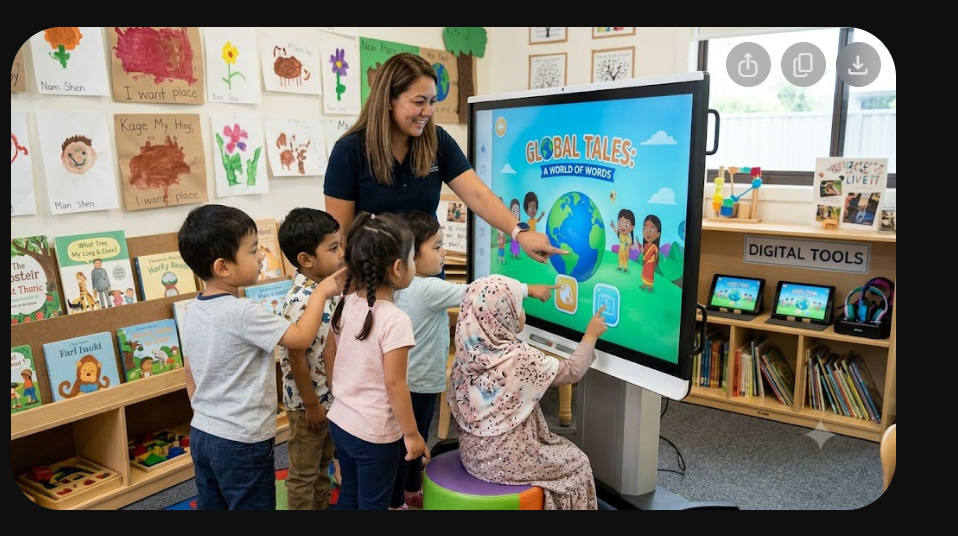
Educators providing social scaffolding during an interactive, technology-aided language learning session with a diverse group of preschool children. Image created via Google AI Image Generation.
The Evolving Landscape of Early Literacy
As digital technologies become increasingly embedded in young children’s daily lives, early childhood educators face a critical question: how do we meaningfully integrate digital literacy into early language learning without compromising proven foundational practices? Traditional print-based methodologies have served early childhood education and care (ECEC) well for decades, yet the rapid influx of technology demands a pedagogical evolution.
Navigating this transition requires examining nuanced research findings. On one hand, recent studies show mixed evidence regarding the comparative efficacy of print versus digital media; for instance, Hare, Johnson, and Vlahiotis (2024) found no strict alignment between reading outcomes, age, language, and the mode of learning (print vs. digital). On the other hand, research by Liang, Zhang, and Sun (2025) underscores potential disparities, noting that digital reading can present varied impacts across socio-economic demographics, where children from lower socio-economic backgrounds may experience fewer direct benefits without deliberate support.
These insights highlight a clear imperative: digital tools alone are not a silver bullet. The quality of early language outcomes depends on how these tools are embedded within classroom practices.
Scaffolding Learning in a Socio-Cultural Setting
Grounded in social constructivism, my research investigates the specific pedagogical methodologies educators use to embed digital literacy skills into language teaching. Through a qualitative observational case study, I have examined how educators provide social scaffolding to facilitate meaningful tech-aided learning.
Rather than replacing physical books or tactile learning, effective practice relies on blended learning. Our findings demonstrate that the most engaged language learning occurs when technology-aided resources are thoughtfully infused into socio-cultural classroom settings. In these environments, children do not passively consume media on screens; instead, technology acts as a catalyst for dialogue, shared concept creation, and peer interaction. Educators play a pivotal role as facilitators who scaffold language development through dialogue, guided questioning, and collaborative play around digital media.
Ethical considerations were central to this study. Working with young children requires robust protocols, including informed parental consent and strict data privacy protections when deploying digital tools. Maintaining these ethical standards ensures that children’s rights and digital wellbeing remain at the forefront of pedagogical innovation.
What to Expect at My EECERA Presentation
During my upcoming EECERA presentation under the Quality Early Childhood Education theme, attendees will gain deeper insights into:
- Practical Scaffolding Techniques: Concrete examples of how practitioners successfully balance digital resources with traditional storytelling and print.
- Observational Case Study Highlights: Qualitative scenarios showing peer interactions and dialogic learning surrounding technology.
- Framework Recommendations: Why existing ECEC developmental milestones must be reviewed to support purposeful, blended learning outcomes.
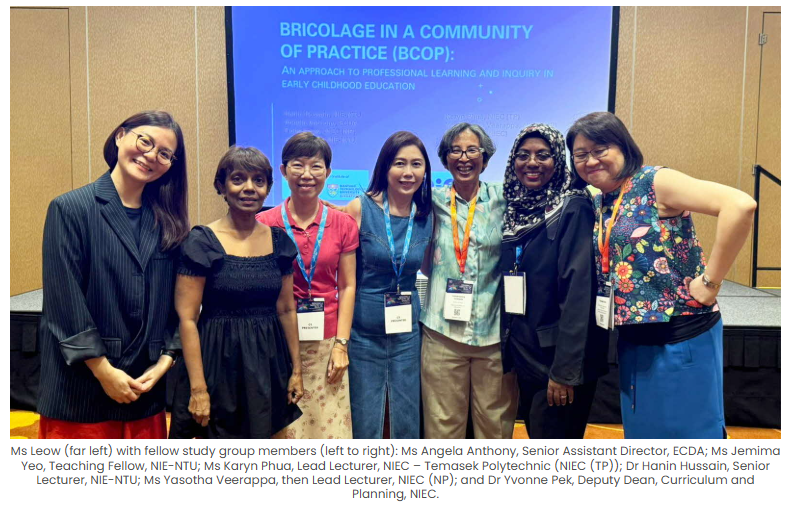
Shared Best Practices: At workshop during the ECDA’s Early Childhood Celebrations & Conference (ECCC) 2025.
Implications for Policy and Practice
To support young learners effectively, early childhood frameworks must undergo a paradigm shift. Policy frameworks need to recognize digital literacy not as an isolated skill or a replacement for print, but as a socio-cultural learning tool that requires skilled educator scaffolding. By updating learning frameworks to reflect these blended realities, we can equip practitioners with the guidance needed to foster high-quality language development for every child.
If you’re interested in this, you may also like:
Sarı Uğurlu, B. (2026). Observing preschoolers’ engagement with a digital book library: insights from children of diverse backgrounds in Türkiye. European Early Childhood Education Research Journal, 34(4), 616–633. https://doi.org/10.1080/1350293X.2025.2529362.
Smith, J. (2026). Supporting educator agency in decisions about digital technologies: a pedagogical decision-making matrix for early childhood education. European Early Childhood Education Research Journal, 1–17. https://doi.org/10.1080/1350293X.2026.2712966.
References & Further Reading
Hare, A., Johnson, B., & Vlahiotis, C. (2024). Mode effects in early literacy: Comparing print and digital reading environments across diverse childhood contexts.
Liang, X., Zhang, Y., & Sun, M. (2025). Socio-economic factors and digital reading outcomes in early childhood education.
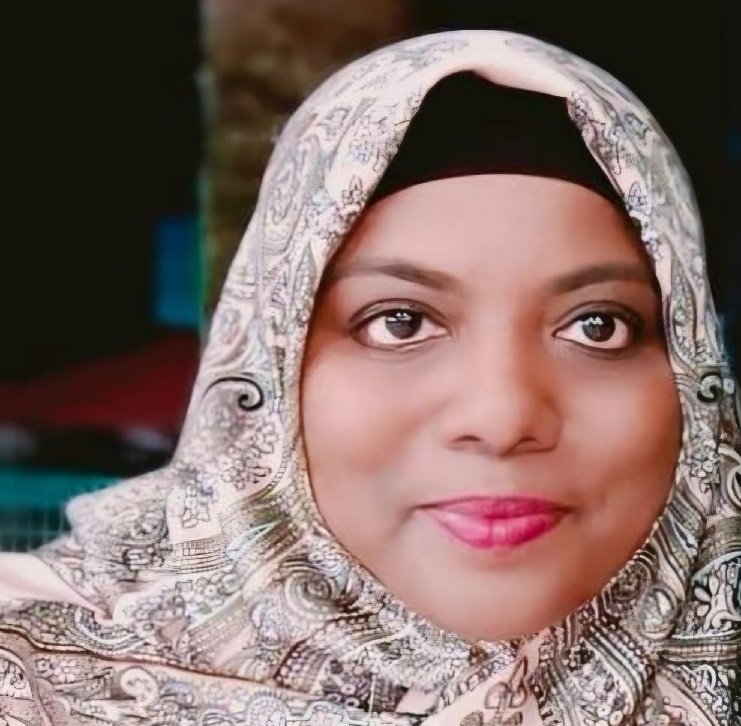
Yasotha Veerappa (@Nurull Syaahidah) is an Adjunct Lecturer and Development Manager for Education at Jamiyah Singapore, specializing in early childhood language development, digital literacy, and pedagogical transformation. Ms. Yasotha holds a Master’s degree in Education (Specialising in Early Childhood Education) from Monash University and a Bachelor’s degree in Early Childhood Education from the University of Wales.
With over 25 years of experience in preschool teaching, leadership, and professional development, she has extensive expertise in guiding centers through SPARK certification and recertification. Her insights on early childhood education and family guidance have been featured in The Straits Times, and she regularly shares best practices across professional platforms, including ECDA’s Early Childhood Celebrations & Conference (ECCC) .
Connect with Yasotha Veera on LinkedIn.
This contribution is one of a series of short blog posts by presenters who will be sharing their work at the upcoming annual conference in Funchal, Madeira. Any views expressed in this post are those of the author(s) and do not necessarily reflect the official stance of their affiliated institution or EECERA.