
When Babies Paint Democracy: Rethinking Arts Education in Day-Care Centres
Posted 17th August 2026
Guest post by Mariana Estrela and Rita Rovisco
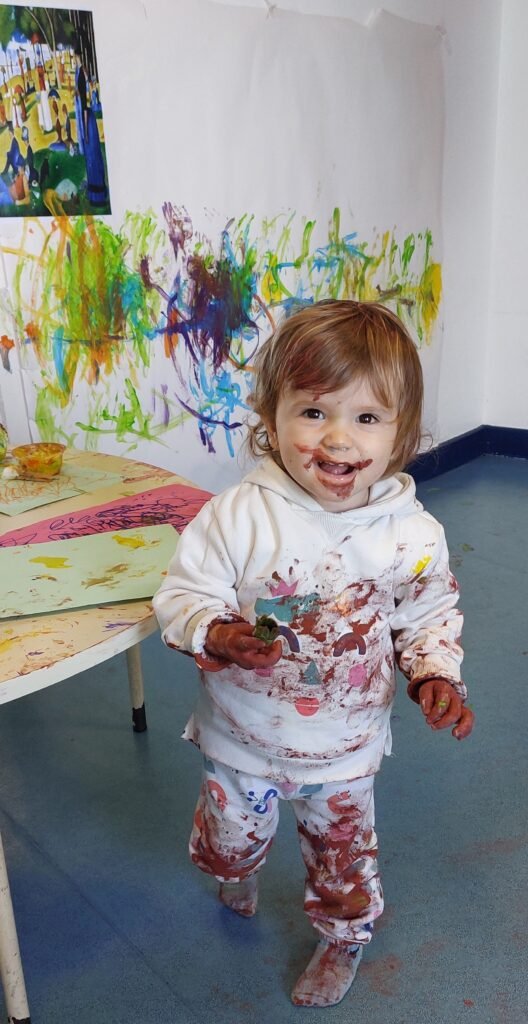
Can babies participate democratically even before they acquire verbal language? Our research suggests they can. Through a series of arts education ateliers developed in a day-care centre, we explored how babies exercise agency, communicate through their bodies, and co-construct pedagogical experiences, challenging traditional understandings of participation in early childhood.
When we think about democracy in education, we often imagine children expressing opinions, making decisions, negotiating rules or taking part in discussions. But what if democracy begins much earlier? What if participation starts before words?
This question gave rise to our research, conducted in a public day-care centre in the Autonomous Region of Madeira, Portugal, with a group of babies aged between 15 and 21 months.
Like many early childhood educators, we began questioning practices that remain common in educational settings for babies: activities planned almost exclusively by adults, proposals directed towards predetermined outcomes, and artistic experiences focused on producing aesthetically pleasing products rather than meaningful learning processes for children.
At the same time, attending a Continuing Professional Development course in Arts Education for Day-Care Centres and Kindergartens profoundly transformed the way one of the educator-researchers came to think about artistic experiences with babies.
What kinds of relationships might emerge if we carefully prepared an environment that genuinely invited exploration?
Inspired by artists such as Joan Miró, Vincent van Gogh and Georges Seurat, she designed a series of ateliers organised across four spatial dimensions – floor, wall, table and air. Rather than directing children towards predetermined outcomes, aesthetically and pedagogically rich environments were intentionally prepared, where materials, space and time invited curiosity, experimentation, investigation and encounter.
What happened next was unexpected. The children continually transformed the experiences that had been prepared.
A small cardboard box became the focus of prolonged artistic investigation. A miniature decorative egg became a tool for exploring pointillism.
Paint unexpectedly moved from cardboard onto hands, feet and faces, and eventually onto another child’s body, giving rise to an extraordinary episode of silent reciprocity between two babies, who negotiated the entire interaction through eye contact, bodily proximity and the gentleness of their gestures. None of these moments had been anticipated. All of them revealed genuine expressions of children’s agency.
Throughout the research, we sought to document not only what the children did, but, more importantly, how they experienced each atelier. We drew upon pedagogical documentation, participant observation, learning narratives, and the process indicators of involvement and well-being developed by Laevers (2005).
The findings revealed consistently high levels of involvement and well-being across almost all pedagogical experiences. It is important to acknowledge, however, that participation did not take the same form for every child. One child within the group frequently moved between different areas of the ateliers, spending relatively little time in any single activity. Nevertheless, this child consistently demonstrated very high levels of well-being, exercising agency through movement, continual circulation and the simultaneous exploration of multiple materials and spaces. Rather than viewing this pattern as a limitation, the research reinforced the importance of recognising the diversity of ways in which babies participate, experience and learn.
We therefore argue that babies do not become participants only once they acquire verbal language. They participate through movement, silence, repetition, touch, the relationships they establish, and the ways in which they transform the environments carefully prepared by educators.
This research also reinforced the importance of continuing professional development, reflective praxis and pedagogical documentation as ethical practices of listening. We learned that, at times, the most meaningful pedagogical decisions are precisely those we choose not to make: waiting, observing, allowing ourselves to be surprised, and enabling children’s own ideas to reshape our pedagogical intentions.
At EECERA 2026, we look forward to sharing how Arts Education can become a genuinely democratic space in which babies are recognised as competent social actors, capable of exercising agency through multiple languages that extend far beyond speech. We also hope to contribute to the international dialogue on participation, inclusion and democracy in early childhood education, demonstrating that these principles begin much earlier than we often imagine. Because sometimes democracy begins with a paintbrush. Sometimes it begins in silence. And sometimes it begins when two babies quietly paint one another, discovering each other through art.
If you’re interested in this, you may also like:
Wallis, N., Bertram, T., & Pascal, C. (2025). Meet me at the museum: creative methodologies for understanding young children’s museum experiences. European Early Childhood Education Research Journal, 33(5), 804–819. https://doi.org/10.1080/1350293X.2025.2489043.
Skriver, J. A., Pedersen, O., Borup Jensen, J., & Skovbjerg, H. M. (2026). Playful opportunities for participation for children under three years and professional practice with infant-toddlers in ECEC: a literature review. European Early Childhood Education Research Journal, 1–16. https://doi.org/10.1080/1350293X.2026.2619585.
About the authors
Mariana Estrela is an Early Childhood Educator, Integrated Researcher at CIE-UMa (Centre for Research in Education, University of Madeira) and holds a PhD in Curriculum and Pedagogical Innovation. Her research focuses on day-care pedagogy, participatory pedagogies, democratic education, pedagogical documentation and children’s agency.
CIÊNCIA ID 711C-AB23-643C
Rita Rovisco is an Arts Educator, teacher trainer and researcher at the Institute of Education, University of Lisbon. Her work focuses on arts education, creativity, teacher professional development and aesthetic experiences in early childhood education.
www.ritarovisco.com @atelier_ritarovisco (instagram)
References
References
Edwards, C., Gandini, L., & Forman, G. (2012). The hundred languages of children (3.ª ed.). Praeger.
Estrela, M. (2023). Conceções e práticas de uma educadora no desvelar da práxis em creche na RAM: Um estudo de caso de natureza etnográfica [Tese de doutoramento, Universidade da Madeira]. http://hdl.handle.net/10400.13/5394
Laevers, F. (2005). SICS (ZIKO): Well-being and involvement in care: A process-oriented self-evaluation instrument for care settings. Research Centre for Experiential Education, Leuven University.
Máximo-Esteves, L. (2008). Visão panorâmica da investigação-ação. Porto Editora.
Oliveira-Formosinho, J., & Araújo, S. (2018). Modelos pedagógicos para a educação em creche. Porto Editora.
This contribution is one of a series of short blog posts by presenters who will be sharing their work at the upcoming annual conference in Funchal, Madeira. Any views expressed in this post are those of the author(s) and do not necessarily reflect the official stance of their affiliated institution or EECERA.