
Professional Work on “Babysitter Pay”?Home-Based Childcare Providers’ Perspectives on Their Inclusion in the German Childcare System
Posted 20th August 2026
Guest blog post by Nina Hogrebe and Solvei Wiederhold, TU Dortmund University, Germany

Photo by Solvei Wiederhold
“We’re being told: ‘Please work in a highly professional way.’ But in the end – to put it very bluntly – you still only get your babysitter pay.”
This statement from a German home-based childcare provider captures a central contradiction in the sector. In Germany, home-based childcare (HBCC) / family childcare (FCC) is legally recognised as an equivalent form to centre-based early childhood education and care for children under the age of three. Yet providers often work under conditions that show that this equivalence is not realised in structural inclusion.
This matters because for many families, HBCC is not simply an alternative to centre-based childcare, but the form of provision that best matches their needs. HBCC offers small group sizes, a family-like setting, and close relationships with one consistent caregiver. HBCC can also play a crucial role for families in rural areas, parents with non-standard working hours, and families seeking cultural or linguistic continuity.
Listening to Providers
Our study examined how HBCC providers perceive their position within the German childcare system. We conducted a secondary “supra-analysis” of material generated through five focus groups involving 22 providers in a large German city. While the original study addressed the local calculation of operating expenses, our analysis went beyond this focus and explored experiences of funding, workload, professional recognition and autonomy. This analysis was based on Melvin et al.’s (2022) framework for including HBCC in publicly-funded systems, as well as further aspects derived from theories of job satisfaction.
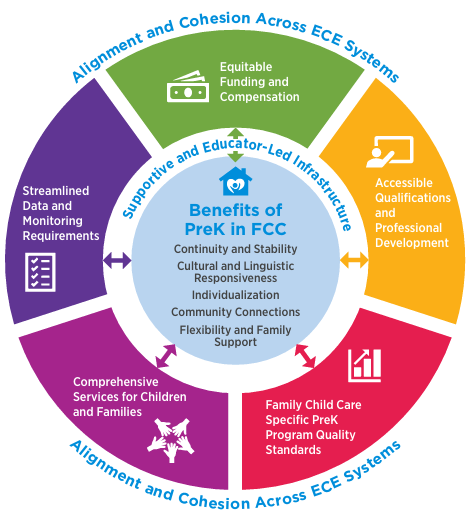
Melvin, S.A., Bromer, J., Iruka, I.U., Hallam, R., & Hustedt, D. (2022). A transformative vision for the authentic inclusion of family child care in mixed-delivery PreK systems. Erikson Institute. https://www.erikson.edu/wp-content/uploads/2023/01/PKFCC-Conceptual-Framework-final.pdf, p. 2.
Self-Employed But with Limited Control
The interviewed HBCC providers are formally self-employed. However, the participants described having little influence on their compensation:
“Any self-employed person can factor their costs into their hourly rate. We can’t do that. That means we receive a fixed rate.”
Participants avoided to request money from parents because they feared becoming less attractive in an increasingly competitive market. At the same time, structural conditions created considerable income insecurity, for instance due to short notice periods and empty places. Thus, providers reported that they carried many risks associated with self-employment without having the corresponding freedom to set prices or shape contractual conditions.
The Hidden Work Behind Quality
The providers also reported rising standards concerning documentation, hygiene, accounting, and pedagogical quality. These requirements may each only take a few minutes, but together they create a substantial workload.
Preparation, documentation, conversations with parents, and professional development also often take place outside paid care hours. Training courses are scheduled in the afternoon, evening or at weekends. This means that the work needed to maintain quality is shifted onto the individual provider and their personal resources and willingness to work unpaid hours.
What Keeps Providers in the Profession?
Despite these pressures, providers spoke positively about the freedom to shape their pedagogical practice. They valued being able to decide how to organise the day, design the care environment, involve parents, and implement their own educational beliefs. This autonomy was a major source of professional motivation for the HBCC providers.
Why This Matters
Our findings suggest that if HBCC is supposed to be a genuinely equivalent form of early childhood education and care, policy must address adequate funding, transparent regulations, appropriate quality standards, and supportive infrastructure. Otherwise, the system will continue to depend on providers compensating for structural shortcomings through unpaid work and private resources. If this leads to providers leaving the field, parental choice and preferences are restricted.
If you’re interested in this, you may also like:
Lemay, L., Lemire, J., Paquette, A., Paquette, N., Bouchard, C., & Bigras, N. (2026). How reliable and valid is measuring interaction quality in Quebec’s home-based childcare with the Classroom Assessment Scoring System Toddler? European Early Childhood Education Research Journal, 1–18. https://doi.org/10.1080/1350293X.2026.2676850.
Shen, J., & Sun, L. (2026). Commodification, subordination, and social disconnection: public responses to China’s home-based child care policy on Douyin. European Early Childhood Education Research Journal, 1–20. https://doi.org/10.1080/1350293X.2026.2690042.
References
Blasberg, A., Bromer, J., Nugent, C., Porter, T., Shivers, E. M., Tonyan, H., Tout, K., & Weber, B. (2019). A conceptual model for quality in home-based child care (OPRE Report Nr. 2019-37). OPRE. https://acf.gov/sites/default/files/documents/opre/cceepra_hbcc_conceptual_model_508b.pdf
Bromer, J., Ragonese-Barnes, M., Miguel, J., Zhang, S., & Melvin, S. A. (2024). Understanding quality in nontraditional-hour child care for children, families, and providers: A literature review and conceptual framework. Erikson Institute. https://www.erikson.edu/wp-content/uploads/2024/07/NTH-Lit-Review-Report-final.pdf
Davis, E., Freeman, R., Doherty, G., Karlsson, M., Everiss, L., Couch, J., Foote, L., Murray, P., Modigliani, K., Owen, S., Griffin, S., Friendly, M., McDonald, G., Bohanna, I., Corr, L., Smyth, L., Mørkeseth, E. I., Morreaunet, S., Ogi, M., & Hinke-Rahnau, J. (2012). An international perspective on regulated family day care systems. Australasian Journal of Early Childhood, 37(4), 127–137. https://doi.org/10.1177/183693911203700418
Hooper, A., & Hallam, R. (2021). An in-depth examination of family child care providers and their engagement with outside systems using a mixed methods case study approach. Children and Youth Services Review, 123. https://doi.org/10.1016/j.childyouth.2021.105959
Melvin, S.A., Bromer, J., Iruka, I.U., Hallam, R., & Hustedt, D. (2022). A transformative vision for the authentic inclusion of family child care in mixed-delivery PreK systems. https://www.erikson.edu/wp-content/uploads/2023/01/PKFCC-Conceptual-Framework-final.pdf
About the Authors
Nina Hogrebe is a Professor of Early Childhood Education and Care at the Department of Educational Sciences and Psychology at TU Dortmund University, Germany.
Solvei Wiederhold is a Research Assistant in the field of Early Childhood Education and Care at TU Dortmund University, Germany.
The work referred to in this blog post will be presented in Symposium Set F, Thursday 27th August 2026, 15:45-17:00.
Find out more about our work:
https://isep.ep.tu-dortmund.de/institut/personen/nina-hogrebe/
https://isep.ep.tu-dortmund.de/institut/personen/vorlage-5-1/
This contribution is one of a series of short blog posts by presenters who will be sharing their work at the upcoming annual conference in Funchal, Madeira. Any views expressed in this post are those of the author(s) and do not necessarily reflect the official stance of their affiliated institution or EECERA.