
The Good Childhood: Children’s Voices from Denmark, the Netherlands and the United States
Posted 19th August 2026
Guest post by Maureen Vandermaas-Peeler, Jen Duncan-Bendix and Ruben Fukkink
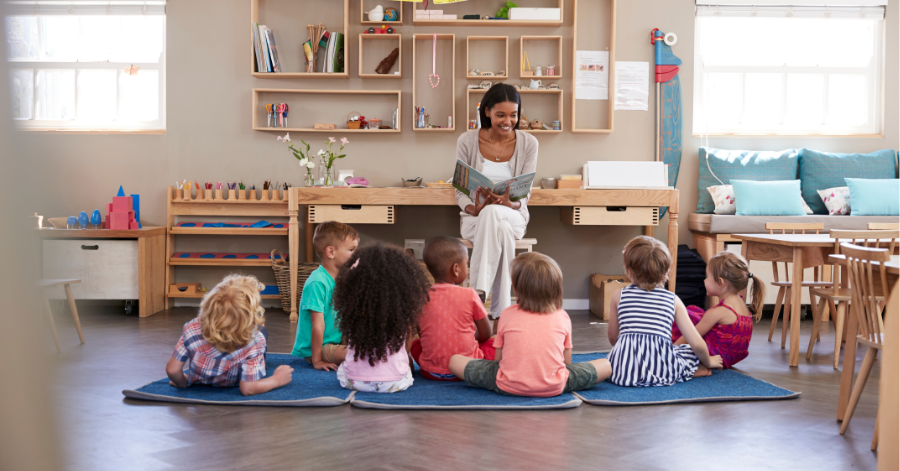
What does it mean to have a good childhood?
In Nordic countries there is a shared ideological framework related to a good childhood (GC), en god barndom in Danish, based on the idea that children have fundamental rights to a high quality of life, including the freedom to enjoy childhood and be well-cared for by their families and the larger society. Although scholars have investigated these ideals in Nordic ECEC beliefs and practices, little known research has compared a GC in countries outside of Nordic contexts. As three researchers based in the United States, Denmark, and the Netherlands, we aimed to address this gap in a study conducted in 2024-2025.
We also wanted to bring young children’s voices into the conversation, so we invited 4- to 5-year-olds in each of the three countries to share their perspectives. There were 116 children in our study, including 22, 56, and 38 children from 8 early childhood centers and programs (2 DK, 3 NL and 3 US). Interviews were conducted in Danish, Dutch, and English, respectively.
To facilitate cross-cultural comparisons, we invited children to share their ideas about four concepts linked with GC frameworks: fun and not fun, fair and not fair, safe and not safe, and belonging and not belonging. We used a mosaic method, offering children multiple tools, including drawing, storytelling, and photography. Our EECERA 2026 presentation will focus on their drawings.
What was the purpose of our study?
We investigated two primary questions in this study:
- How do children understand the four concepts of fun, safe, fair, and belonging, including positive and negative perceptions, related to GC?
- Are there shared patterns in children’s perceptions of these concepts across the three countries, supporting a common understanding of GC?Or are there unique patterns emphasizing the importance of distinctive sociocultural contexts?
What did we find?
The children drew up to eight pictures each, representing the positive and negative valence of each concept. Interestingly, some children exercised agency by choosing not to draw, or in some cases, to draw what they wanted rather than responding to our prompts. Of the 503 drawings we collected, we were able to code 392. We conducted both qualitative and quantitative analyses on the drawings.
Across the three countries, children drew more realistic, outdoor scenes than indoor settings. They often chose nature-related themes, including real people and especially children. There were clear differences in the ways children represented the four different GC concepts, which we will discuss in our presentation. As one example, the figure below represents a Danish (A), U.S. (B), and Dutch (C) child’s drawings of belonging.
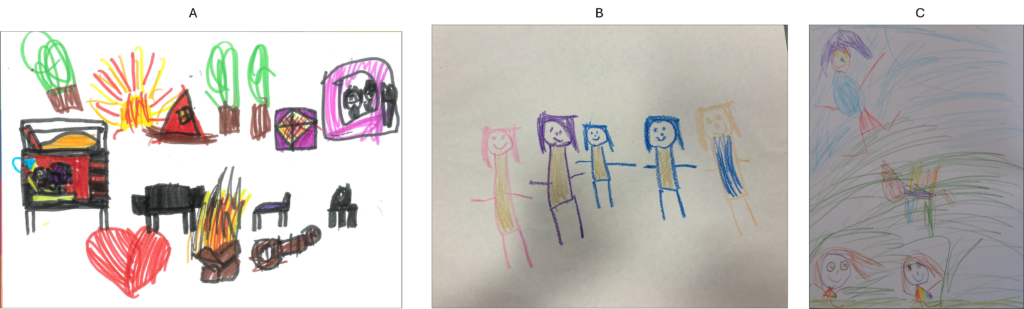
Belonging was often drawn as being-with-others through shared activities. Belonging drawings often expressed excitement and joy, often in a social context, sometimes indicated with open postures of two children, touching hands or a heart symbol.
The Danish drawing in Figure A depicts the theme of belonging as deeply place‑based, centered on home‑nests (beds, duvets, pillows, sofas), chosen micro‑places (drawing desks, backyard swings), and familiar routines that create predictable comfort.
As seen in the US context in Figure B, children often drew themselves holding hands with friends and family, meeting new friends at a park, playing with cousins, and walking on the beach with a parent.
Belonging drawings also illustrated being together in activities at school, especially in the Dutch context as depicted in Figure C, and included peers, sometimes staff and occasionally a parent, like a mother who joined the class to read aloud her favorite book. The people from these drawings were at a close distance, with a mutual gaze and often smiling.
What can we conclude?
We explored children’s perspectives on four dimensions of a good childhood, including fun, fairness, safety, and belonging. Their drawings demonstrate that young children hold clear views on what constitutes a good childhood and are capable of expressing these perspectives.
Our findings emphasize the importance of including young children’s viewpoints in discussions of childhood agency and recognizing them as active contributors to knowledge about their own lives. Incorporating children’s voices more systematically into research and policy discussions on childhood can deepen our understanding of their everyday lives and support the development of practices that are more responsive to children’s lived experiences.
We look forward to sharing more about our work at the conference.
If you’re interested in this, you may also like:
Zang, L., Zhu, M., & Ma, Y. (2025). Exploring children’s perceptions of family relationships in China through kinetic family drawing: insights from 5- to 6-year olds. European Early Childhood Education Research Journal, 33(2), 333–351. https://doi.org/10.1080/1350293X.2024.2437763.
Carpi, C., L. Almli, V., & Wegedahl, H. (2026). ‘What would you serve as a cook in your kindergarten?’ Children’s taste perceptions and experiences across seven dimensions – a qualitative study in Norwegian kindergartens. European Early Childhood Education Research Journal, 1–18. https://doi.org/10.1080/1350293X.2026.2705507.
Selected References
Aasgaard, Reidar, Marcia Bunge, and Merethe Roos, Eds. 2017. Nordic childhoods 1700–1960: From folk beliefs to Pippi Longstocking. Routledge.
Berti, Sara, and Ada Cigala. 2022. “DRAW. IN. G.: A tool to explore children’s representation of the preschool environment.” Frontiers in Psychology 13: 1051406. https://doi.org/10.3389/fpsyg.2022.1051406
Clark, Alison, and Peter Moss. 2011. Listening to young children: The mosaic approach (2nd. ed.). Jessica Kingsley Publishers.
Einarsdóttir, Jóhanna. 2008. “Children’s and parents’ perspectives on the purposes of playschool
in Iceland.” International Journal of Educational Research 47 (5): 283-291.
Einarsdottir, Johanna, and Judith T. Wagner, eds. 2006. Nordic childhoods and early education: Philosophy, research, policy and practice in Denmark, Finland, Iceland, Norway, and Sweden. IAP.
Kukkonen, Tiina, and Sandra Chang‐Kredl. 2018. “Drawing as social play: Shared meaning‐making in young children’s collective drawing activities.” International Journal of Art & Design Education 37 (1): 74-87.
Pulkkinen, Lea. 2012. “Ten pillars of a good childhood: A Finnish perspective.” Childhood education 88 (5): 326-330. DOI: 10.1080/00094056.2012.718680
Wagner, Judith T. 2006. “An outsider’s perspective: Childhoods and early education in the Nordic countries.” In J. Einarsdottir. JT Wagner (Ed..), Nordic childhoods and early education, 289-306.
About the authors
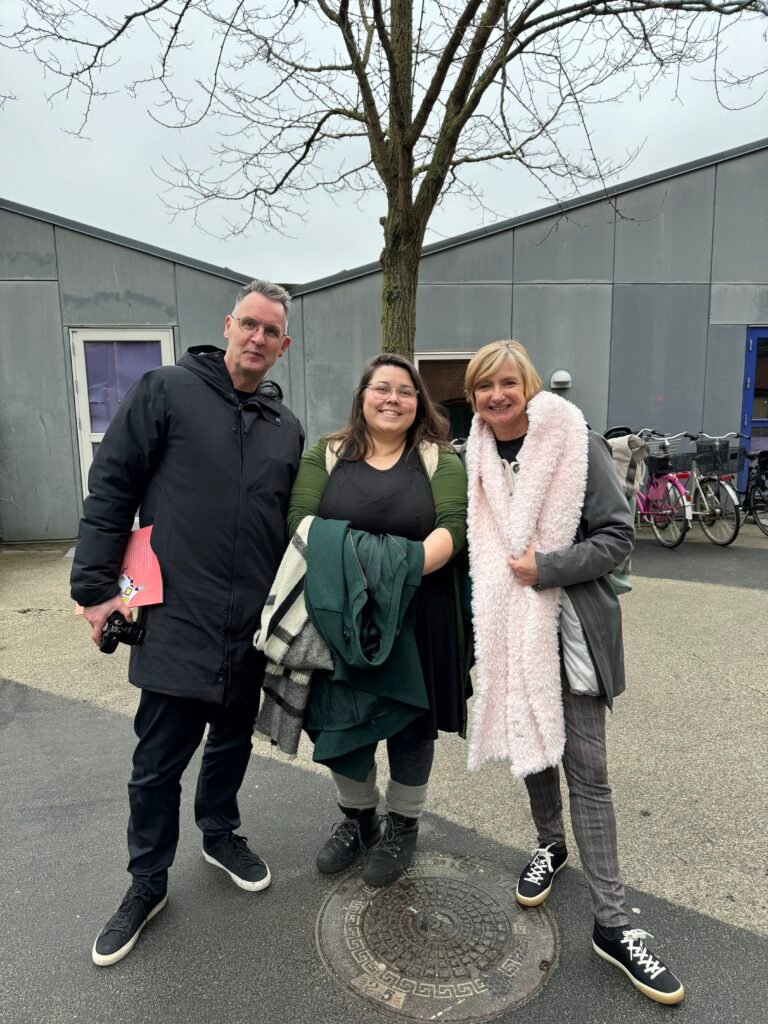
Caption: From the left: Ruben Fukkink (University of Amsterdam & Amsterdam University of Applied Sciences, Amsterdam, the Netherlands), Jennifer Duncan-Bendix (Aarhus University, Denmark) and Maureen Vandermaas-Peeler (Elon University, U.S.).
This contribution is one of a series of short blog posts by presenters who will be sharing their work at the upcoming annual conference in Funchal, Madeira. Any views expressed in this post are those of the author(s) and do not necessarily reflect the official stance of their affiliated institution or EECERA.