
Too Tired to Listen? How Educator Wellbeing Unlocks the Building Blocks of Child Agency
Posted 23rd August 2026
Guest post by Cecilia Wong and Natasha Tania Stansilas
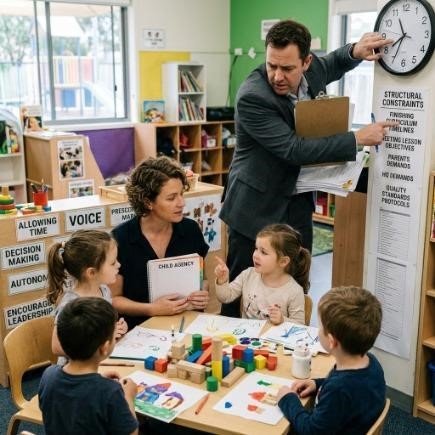
Image by Google. (2026). Gemini (July 2026 version)
Child-centred, participatory practice is now widely endorsed. Yet in real classrooms, participatory practice stays uneven, often squeezed out by institutional pressures and daily behaviour-management demands.
Singapore preschools operate under stringent government guidelines and quality-assurance frameworks. Educators often face these tensions in a fast-paced environment with long childcare hours, juggling curriculum expectations, parent partnerships, and workload demands. Amid this pressure, a quieter, more honest conversation is happening in staff rooms across the sector.
“It’s tiring, time-consuming to listen to everyone’s voices, wait for child-led decisions… we cannot finish the lessons. Parent-teacher conference and graduation are coming soon… I need to complete XXX.”
This is the gap our research set out to explore: the space between knowing and doing. That gap isn’t really about knowledge — it’s about wellbeing. If an educator is running on empty, how much bandwidth do they have to slow down, listen, and hand decisions back to a four-year-old?
While child agency has been widely explored from children’s and pedagogical perspectives, much less attention has been given to the internal conditions that enable educators to enact child agency consistently.
What do we actually mean by “child agency”?
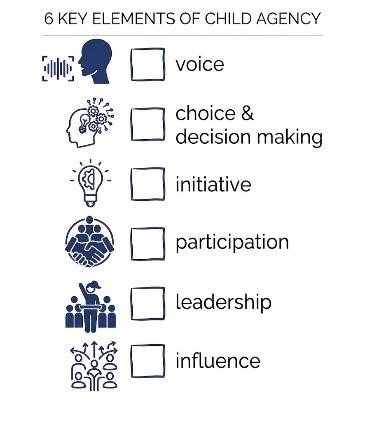
We grounded our definition in Singapore’s own Nurturing Early Learners Framework, alongside Article 12 of the UN Convention on the Rights of the Child and the OECD’s Learning Compass 2030.
To make this observable in everyday practice, we translated it into six key elements, aligned with Singapore’s national teaching quality framework.
The study: reflection as a catalyst
A 12-week action research study was conducted with12 educators across multiple early childhood centres in Singapore. We built a structured self-reflection tool grounded in Martin Seligman’s PERMAH framework (Seligman, 2011), prompting educators to check in on their wellbeing state regularly. Through iterative reflective cycles, participants worked with pre- and post-surveys, PERMAH-structured digital journals, and semi-structured interviews, generating multiple sources of qualitative data for analysis.
What we found
“I learned that I can also let go, be more flexible, and stop myself from being too controlling about how the class or activities should be done. …it was actually meaningful to see children taking ownership…”
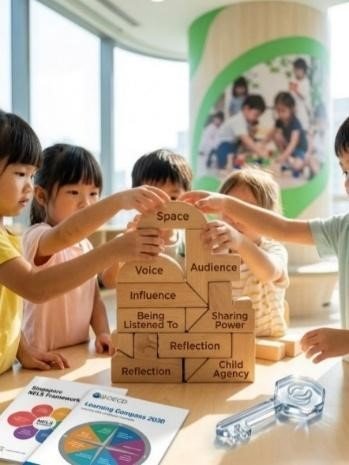
Even within a short 12-week window, the shifts were striking. Educators described genuine “aha” moments about their own emotional patterns and a rekindled motivation for their work. For example, they became more intentional in noticing children’s ideas, creating more opportunities for shared decision-making, and rethinking how everyday routines either enabled or constrained child agency. As their self-awareness grew, so did their capacity to notice, honour, and respond to children’s own bids for agency. Through this study, we developed a practical child agency framework that translates theory into observable dimensions, applies structured reflective methods, and identifies distinct educator trajectories.
Join us at the conference
While the research is situated within Singapore, the tensions it explores are shared across many early childhood systems internationally. Educators’ wellbeing may be a critical, yet often overlooked, condition for enabling child agency more broadly. We’re excited to share the full findings, including the distinct “profiles” of change across our educators, at our conference presentation. We’d love to see you there.
If you’re interested in this, you may also like:
Ha, N., Byun, S., Lang, S., & Jeon, L. (2025). Qualitative study on Social-Emotional Learning for Teachers (SELF-T): a professional development intervention promoting early childhood educators’ knowledge of emotional well-being. European Early Childhood Education Research Journal, 33(4), 727–741. https://doi.org/10.1080/1350293X.2024.2425947.
Trauernicht, M., Anders, Y., Oppermann, E., & Klusmann, U. (2023). Early childhood educators’ emotional exhaustion and the frequency of educational activities in preschool. European Early Childhood Education Research Journal, 31(6), 1016–1032. https://doi.org/10.1080/1350293X.2023.2217485.
About the Authors


Cecilia Wong and Natasha Tania Stansilas are Senior Educational Leadership Specialists in the Child Development Department at NTUC First Campus Limited, Singapore. Their work includes strengthening teacher-leaders’ wellbeing and pedagogical practice across early childhood centres, with a particular interest in the relational conditions that make genuine child participation possible.
References
Dockett, S., & Perry, B. (2014). Continuity of learning: A resource to support effective transition to school and school age care. Australian Government Department of Education.
Early Childhood Development Agency. (2024). Quality teaching tool. https://www.ecda.gov.sg/docs/default-source/default-document-library/qtt-tool_24-sep.pdf
Emilson, A., & Johansson, E. (2009). The desirable toddler in preschool: Values communicated in teacher and child interactions. In D. Berthelsen, J. Brownlee, & E. Johansson (Eds.), Participatory learning in the early years: Research and pedagogy (pp. 61–77). Routledge.
Gillett-Swan, J. K., & Sargeant, J. (2018). Unintentional power plays: Interpersonal contextual impacts in child-centred participatory research. Educational Research, 60(1), 1–16. https://doi.org/10.1080/00131881.2017.1410068
Greene, S., & Nixon, E. (2020). Children as agents in their worlds: A psychological–relational perspective (1st ed.). Routledge. https://doi.org/10.4324/9781315625911
Lundy, L. (2007). “Voice” is not enough: Conceptualising Article 12 of the United Nations Convention on the Rights of the Child. British Educational Research Journal, 33(6), 927–942. https://doi.org/10.1080/01411920701657033
Ministry of Education. (2022). Nurturing early learners: A curriculum framework for preschool education in Singapore. https://www.moe.gov.sg/-/media/files/mk/nurturing-early-learners-nel-framework-2022.pdf
Organisation for Economic Co-operation and Development. (2019). Student agency for 2030 (OECD Learning Compass 2030 concept note). https://www.oecd.org/education/2030-project/teaching-and-learning/learning/student-agency/Student_Agency_for_2030_concept_note.pdf
Seligman, M. E. P. (2011). Flourish: A visionary new understanding of happiness and well-being. Free Press.
Shier, H. (2001). Pathways to participation: Openings, opportunities and obligations. Children & Society, 15(2), 107–117. https://doi.org/10.1002/chi.617
United Nations. (1989). Convention on the rights of the child. Treaty Series, 1577, 3. https://www.ohchr.org/en/instruments-mechanisms/instruments/convention-rights-child
This contribution is one of a series of short blog posts by presenters who will be sharing their work at the upcoming annual conference in Funchal, Madeira. Any views expressed in this post are those of the author(s) and do not necessarily reflect the official stance of their affiliated institution or EECERA.