
Keynote Speakers
Prof. Suzy Edwards
Advancing Children’s Participation in The Digital Age through Philosophy of Technology
Young children are growing up in a digital age characterised by technologies that mediate how practices are enacted amongst people in the formation of societies. As this level of digital complexity has evolved over time, so too have the demands on early years education developed to ensure young children have opportunities for agentic digital learning in practice. In this session, philosophy of technology is explored as a viable knowledge base for the early years, advancing thinking from the limitations of technical determinism through to the democratic possibilities of critical constructivism in practice.
Suzy Edwards bio
Susan Edwards is Professor of Early Childhood Education at Australian Catholic University. She has researched young children and their adults using digital technologies, digital media and popular culture in their play and learning for many years. Susan has been awarded over $1.5 million in research funding to develop insights into young children’s cultural meaning-making with digital technologies through play. She is interested in advancing knowledge and pedagogical practices that help keep young children safe online. This includes amongst the first work nationally and internationally with colleagues to determine what young children know and understand about the internet. Professor Edwards is a co-author of the Early Childhood Australia Statement on Young Children and Digital Technologies. Her publications include over 80 books, journal publications and reports.
Reema Patel
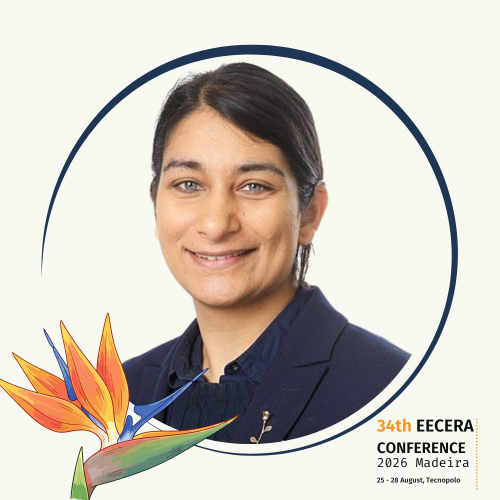
Nothing About Them Without Them: Children’s Civic Participation and Inclusion in AI
Civic participation is increasingly recognised as essential to data and AI governance, shaping a vision of what Patel describes in her forthcoming book as ‘glass box’ AI, moving away from the dominant paradigms of surveillance capitalism, black box and deficit models towards empowerment-based models rooted in narratives of stewardship and care. Power dynamics are already asymmetrically structured between parents, teachers and children, and the acceleration of AI presents a new challenge and risk of exacerbating them, excluding children and young people from important conversations about their futures.
The presentation introduces Patel’s social model of digital technology, shaped by her practical policy facing research work with governments and policymakers – drawing upon disability rights movements and theory, to explain how digital exclusion for young people in the age of AI is socially produced, not inherent. She argues for a philosophical approach called conceptual engineering to address limiting mental models embedded in technology development so that young people and children are truly empowered. Through case studies and practitioner examples, the talk illustrates how civic participation rooted in conceptual engineering can enable tangible power shifts — redistributing agency, authority, and decision-making capacity.
This talk also presents examples of how children are already being involved in shaping AI governance, drawing on models such as school assemblies, play based models using Lego, arts and creative models, as well as deliberative AI Children’s Summit convened by the Alan Turing Institute. It also showcases a practical framework for participation and inclusion in AI that moves beyond consultation toward meaningful power-sharing, adapted for youth practitioners. Integrating insights from youth participatory praxis, Patel’s prior research on participatory data stewardship at the Ada Lovelace Institute, and her approaches to public involvement in shaping responsible AI at the ESRC Digital Good Network, the framework reconceptualises both civic participation and inclusion as a pedagogical, infrastructural, social, and technical challenge for children and young people.
Attendees will learn from a structured approach to designing participatory processes that are inclusive, reflexive, and capable of influencing real-world data and AI systems, presented in Patel’s self assessment workbook for including public voices in AI.
Reema Patel bio
Reema Patel is a social researcher and participatory practitioner based in Cambridge, UK working at the intersection of civic participation, data stewardship, and responsible AI. She co-founded the Ada Lovelace Institute where she established its flagship work programmes on public participation and participatory data stewardship and authored reports on Rethinking Data, the Data Divide, Beyond Face Value and many more. Reema is now the director of Elgon Social Research, where she collaborates with communities, policymakers, and practitioners to design participatory processes that enable meaningful power-sharing in technology and social policy, rooted in methodologies of praxis experimentation and action learning.
She has contributed to national research on public involvement in AI through the ESRC Digital Good Network, developing new frameworks for including public voices in shaping AI futures, shaping practitioner materials; and is an advisor to the UK’s research and innovation expert resource centre Sciencewise, supporting policymakers to involve the public in emerging science and technology issues. Reema’s research focuses on rethinking inclusion in the datafied and AI driven-age, addressing digital exclusion, and developing practical methods that centre young people and marginalised communities in shaping data-driven and AI-enabled futures.
She is also a research fellow of the Leverhulme Centre for the Future of Intelligence, based in Cambridge University. Prior to her work in AI, she was best known for her work on the UK government Sciencewise public engagement programme, and her leadership of the Royal Society of Arts’ Citizens’ Economic Council initiative, where she worked with schools and children using Lego based methodologies to engage them in thinking about economic futures. Reema worked closely with the UK central bank, the Bank of England, to embed their regional citizen economic panels as a result of this research.
Prof. Júlia Formosinho
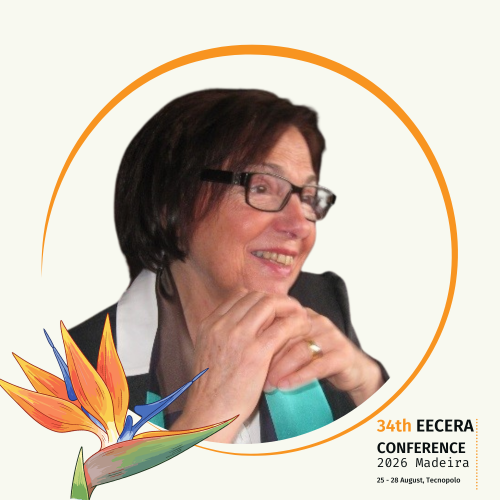
Children and Teachers in a Joint Learning Journey for Democracy Development
We know that children’s early years lived experiences are central for their development of personal and social identities. We know that societies and educational systems need to optimize their contribution for children’s early understanding about the civic power and ethic and aesthetic beauty of democracy. In the daily life of educational contexts, educators can deeply contribute to the democratic experiences of their children. This contribution can be facilitated by many factors, among them the rights of teachers for quality professional development. The connected democratic processes of early years education and teachers’ education can represent a hope in the development of a more humanistic society.
Júlia Formosinho bio
Professor Julia Formosinho has been Professor in Early Childhood Education at University of Minho (1998-2012) where she led the Master’s in Early Childhood Education. She is founder and Vice-president of Childhood Association, an independent charity, based in Braga supported by Gulbenkian Foundation and Aga Khan Foundation. She has been since 1996 Director of the Childhood Association Research Centre in Early Childhood Education where she specialised in early childhood research projects that integrate professional development, children’s learning and praxeological research within projects such as Childhood Project: Supporting Children’ and Families Rights and Context Based Professional Learning.
Julia entered the Early Childhood Education (ECE) field in 1988 having initially studied children’s sociomoral civic development. In the initial years of her work in ECE she developed a process for the supervision for early childhood student teachers which began her enduring commitment to the professional development of their supervisors. This led her to the question of how to sustain a type of professional development which had visible impact on the ways young children learn. Since then this has been the central concern of her teaching, research, intervention, publication, activities.
She is co-founder of the Childhood Association, and was director of its research centre. The Childhood Association promoted a socio-cultural-constructivist approach to the education of children and teachers, intercultural understanding and advocacy of children’s rights in early childhood settings. In this context she developed, in collaboration with Joao Formosinho and other colleagues, an approach for childhood education (pedagogy-in-participation) as well as a connected approach to professional development (Participatory Context Based Professional Development) and praxeological research as the study of transformation.
Since 1996, she has been the editor of a series for the leading educational publishing house in Portugal and African Portuguese speaking countries – Porto Editora – called Childhood Serieswith 22 titles publishedFrom 2010 to 2013 she coordinated a national project, under the auspices of the Ministry of Education, on the development of quality in early childhood education settings emphasizing participatory assessment and evaluation through a deep dialogue with Chris Pascal and Tony Bertram.
Julia has had a long-standing collaboration with Spanish universities and professional associations, namely with the University of santiago de compostela. She is a member of ILADEI (a Latin American network for childhood education) and its Journal. She also has a large interchange with Brazilian universities (São Paulo, Ceará, Rio Grande do Sul) that started with the Faculty of Education of the University of São Paulo. She has co-coordinated four books in Brazil, written chapters in several books and published in Brazilian research journals. The last one was the translation of an updated version of the first book on EECERA book series.
Julia has been an active participant in EECERA conferences since the early nineties and is currently a member of the Board of Trustees, of the editorial Board of the Journal and the EECERA Editorial Panel. Julia has worked consistently for EECERA and has made a significant contribution to the successful development of the Association.
Prof. Andrew Manches
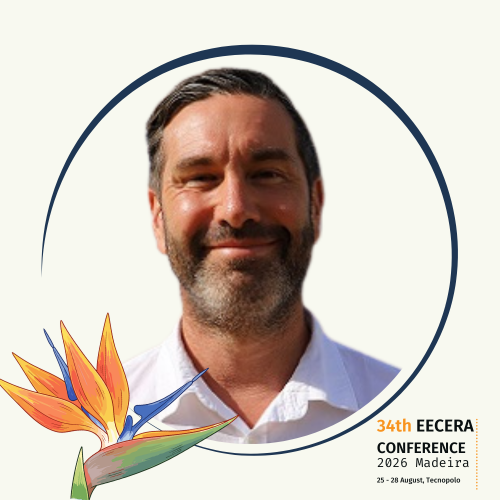
Grasping Data: Ways to Help Children Understand and Navigate Their Increasingly Digital World
We are becoming more and more aware of how increasingly intelligent and ubiquitous devices are capturing data from our personal, often intimate, interactions with the world. This is particularly concerning when considering how many of these devices are targeted at young children, capturing data from everyday engagement through voice recognition, geolocation software, sensors, or cameras. This enables third parties to ‘know’ a child’s birthday, heart rate or whereabouts, to monitor tooth brushing and attention levels, or capture personal conversations and play routines. Children lack agency in these transactions, as consent for their data is either acquired through adult caregivers (who themselves may lack data literacy) or not at all. Indeed, caregivers can sometimes be complicit in data flows – from teachers using apps to record behaviour to parents keeping their children safe using phone location.
Whilst some progress has been made in tackling this issue through legislation, regulation and even design guidelines, there is lack of guidance or resources to empower children directly. Children are considered too young to understand these complexities. Yet, this assumption should be challenged. In a current UK-funded project, ‘Grasping Data’, we are exploring the potential to help children as young as 3 to engage, enjoy, understand, and value their personal data – as a foundation to subsequently reflect on who they’d like to share this value with.
The aim of this talk is to provoke critical discussions about emerging technologies and implications for children and their data. Whilst seemingly dystopian, the talk addresses, and encourages participants’ thoughts on the key question: “what we can do as adults to leverage the value of emerging technologies for young children, whilst moderating potential harms?”
Andrew Manches bio
Andrew Manches is Professor of Children and Technology at the University of Edinburgh where he directs the Children Interaction and Design cluster within Edinburgh Futures Institute. Since moving to academia from a career as an infant then special education teacher, he has led multiple projects examining the role of body-based interaction in how children think and learn, and the implications for emerging forms of technology. His recent work includes being the lead of ‘Grasping Data’, a £1.2million UKRI-funded project (2025-2026) looking at the potential of data physicalizations to help children understand and value their personal data. Andrew works closely alongside practitioners and designers and has spun out two early learning companies to sustain and scale impact from his research.