
Child-centred Belonging: Creating Curricula for Children’s Agency and Participation through Cynefin
Posted 1st August 2026
Guest post by Wendy Briggs and Sharon Phillips
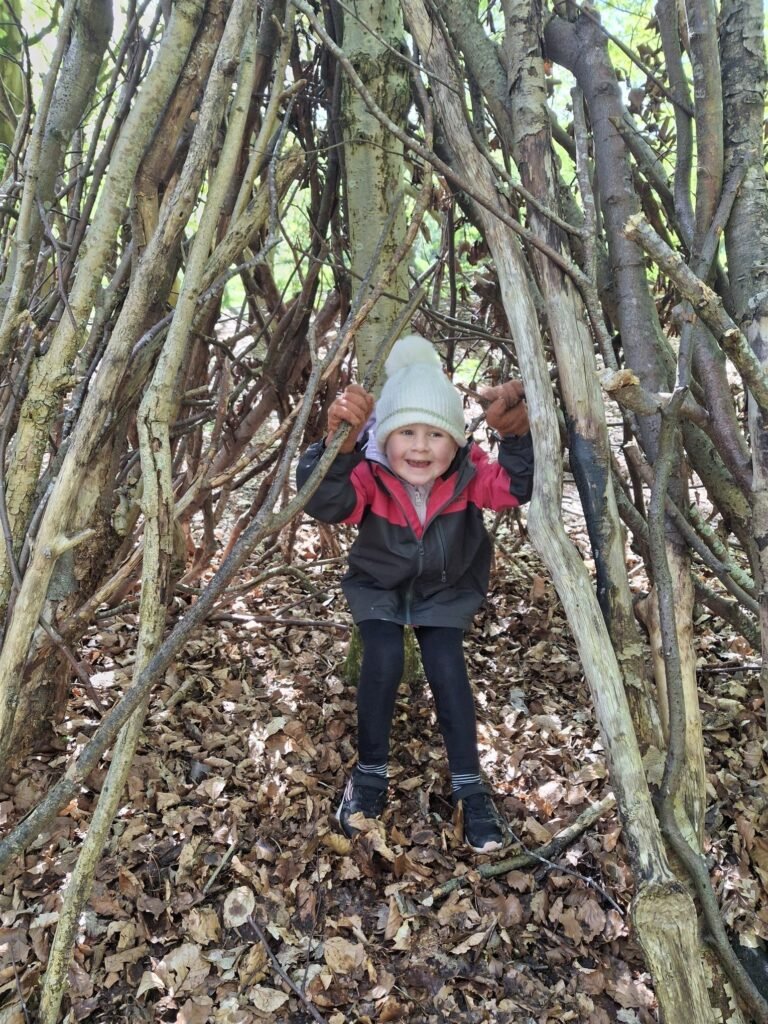
Figure 1. My granddaughter building a den in the forest, immersed in the experiences, relationships and sense of place that shape her cynefin. Through exploring, creating and problem-solving in a meaningful local environment, she demonstrates how place-based pedagogy supports children’s agency, participation and belonging. Photo credit: Wendy Briggs.
How can children develop a sense of belonging in a world that is increasingly connected, mobile and digital?
As early childhood educators, we often focus on preparing children for the future. We consider the knowledge, skills and dispositions they may need to navigate an uncertain and rapidly changing world. Yet before children can become active citizens of that world, they first need to develop a sense of where they belong within it.
In Wales, the concept of cynefin offers a powerful way of understanding belonging through relationships, culture, language, place and lived experience. Our research explores how cynefin can be used as a pedagogical lens for place-based learning, supporting children’s agency and participation while helping them build meaningful connections to their communities.
Across many countries, growing attention is being given to the role of belonging in supporting children’s well-being, identity and participation. Within the Curriculum for Wales, cynefin provides a distinctive framework for exploring these ideas. This is particularly important at a time when children’s experiences increasingly span both local and digital communities. We argue that cynefin can be understood not only as a curriculum concept, but also as a pedagogical lens that supports place-based learning and meaningful connections between children, their communities and the wider world.
Why this research matters
Children today move seamlessly between physical and digital spaces. They develop relationships within families and local communities while also engaging with technologies that connect them to wider national and global conversations.
This changing landscape raises important questions for educators. How do we ensure that digital innovation strengthens rather than replaces children’s connection to place? How can learning remain grounded in children’s lived experiences while opening windows to the wider world? Most importantly, how can curriculum design support children to become active participants in shaping both their communities and their futures?
These questions underpin our research and reflect wider international discussions about children’s participation, belonging and engagement in contemporary society.
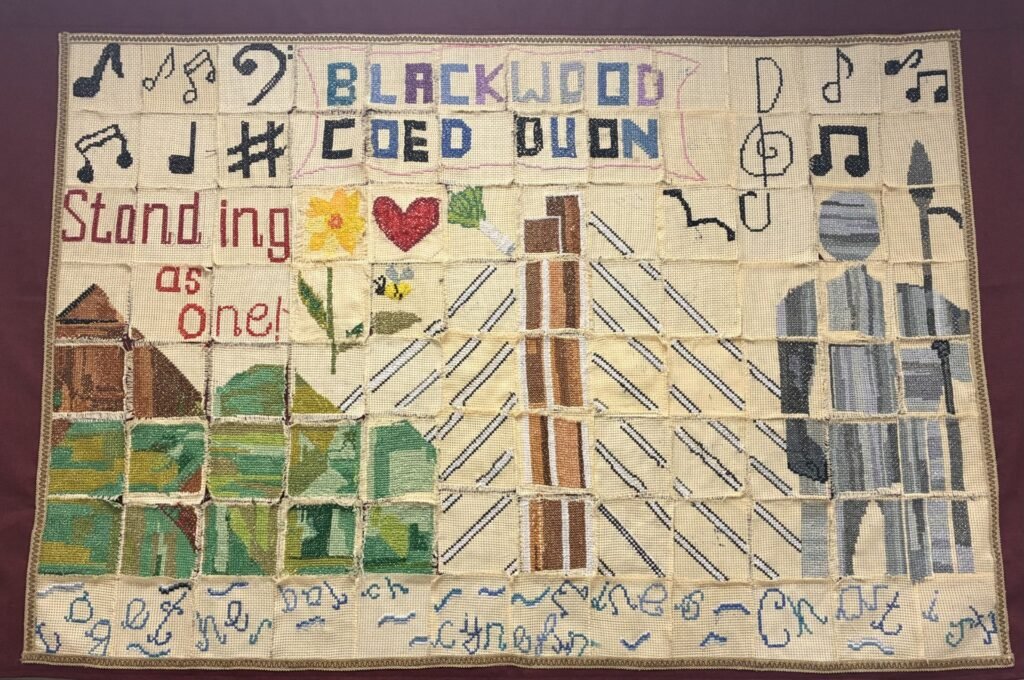
Figure 2. This pit banner, created by pupils in Blackwood, demonstrates place-based learning in action. By exploring their community’s mining heritage and sharing stories of local significance, children actively constructed knowledge about their identity, culture and sense of belonging. Photo credit: Courtesy of Mrs Williams, Blackwood.
Building on previous research
The study draws on place-based education research (Gruenewald, 2003; Sobel, 2013) and evidence linking belonging, participation and well-being (Riley et al., 2020). Importantly, the study extends recent work exploring cynefin within the Curriculum for Wales (Chapman et al., 2023), considering how this distinctly Welsh concept can inform contemporary pedagogical practice in early childhood education.
Looking through an ecological lens
The research is framed by Bronfenbrenner’s ecological systems theory alongside sociocultural perspectives on learning. Together these frameworks recognise that children’s development is shaped through interconnected relationships across home, school, community and wider society. Within this ecological understanding, cynefin connects children’s relationships, experiences and sense of place. Digital technologies can complement this learning by helping children document, interpret and share their experiences.
What does the study suggest?
Drawing on policy, research and practitioner literature, the study explores the implications of cynefin for early childhood practice. The emerging discussion suggests that pedagogies informed by cynefin can strengthen children’s agency by embedding learning within relationships, lived experiences and meaningful engagement with place. When children investigate their local communities, listen to stories from family members, engage with local organisations and use digital technologies to communicate their learning, they become active participants rather than passive recipients of knowledge. This approach positions curriculum as something children help to construct through participation, enquiry and collaboration. Learning becomes rooted in authentic experiences that matter to children while also creating opportunities to engage with wider social, cultural and global contexts.
Why this matters beyond Wales
Although cynefin is uniquely Welsh, the questions it raises about belonging, identity and participation are relevant across diverse educational contexts. Rather than presenting cynefin as a model to be transferred directly elsewhere, this research offers it as a distinctive perspective that contributes to wider conversations about place-based pedagogy, democratic participation and child-centred curriculum design.
Ultimately, cynefin reminds us that belonging is not something children inherit simply because they are born in a place. Rather, it is something they develop through relationships, participation, shared stories and meaningful contributions to the communities in which they live.
This message was brought to life through the words of Welsh poet and author Myrddin ap Dafydd, whose reflections on Welsh history, language and identity resonated strongly with our research. A particularly moving moment came when he shared a cynefin poem written for children in a school in Blackwood. The poem captured a journey from the industrial heritage of the South Wales Valleys to Patagonia, illustrating how stories, culture and place connect generations across time and distance.
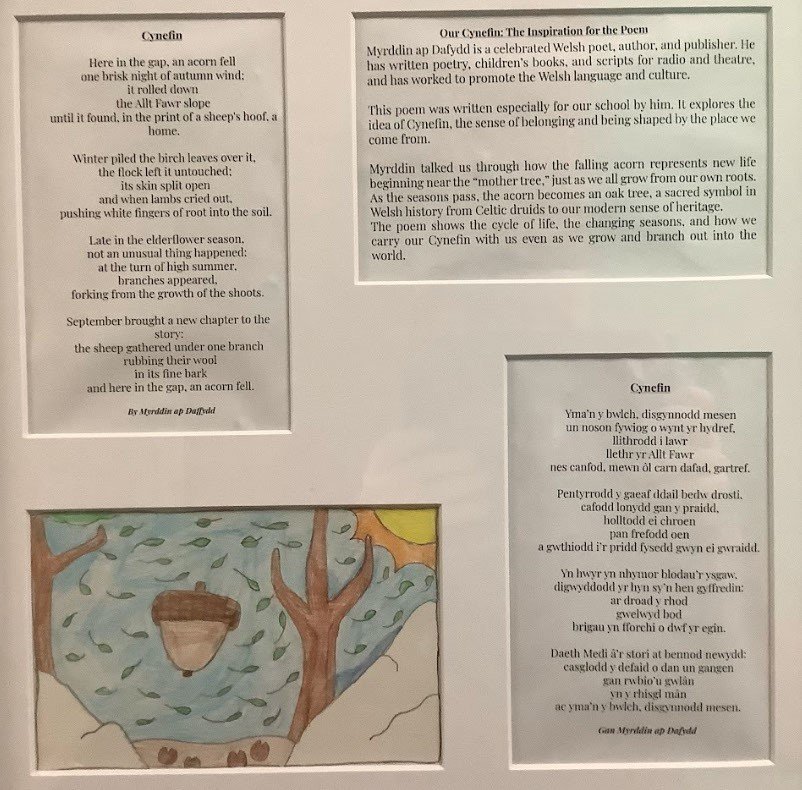
Figure 3. A poem specially written by Myrddin ap Dafydd for pupils in Blackwood. Through references to local heritage, Wales and Patagonia, the poem demonstrates how cynefin is shaped through stories, culture and shared experiences. As a learning resource, it supports place-based pedagogy by helping children explore identity, belonging and their connections to community. Photo credit: Poem by Myrddin ap Dafydd; photograph reproduced with permission from Mrs Williams, Blackwood.
It reminded us that while history helps us understand where we come from, cynefin is something we carry forward. It shapes who we are, how we connect with others and how children come to understand their place in an ever-changing world. As educators, creating opportunities for children to develop that sense of belonging may be one of the most important foundations we can offer for their future learning and participation.
At the conference, we look forward to discussing this work and engaging with colleagues about how belonging, agency and place continue to shape young children’s learning across different cultural contexts.
If you’re interested in this, you may also like:
Magnusson, L. O. (2026). Children’s perceptions of the indoor environment of early childhood education: following children’s photographic voices. European Early Childhood Education Research Journal, 34(2), 195–210. https://doi.org/10.1080/1350293X.2025.2490184.
Wallis, N., & Noble, K. (2022). Leave only footprints: how children communicate a sense of ownership and belonging in an art gallery. European Early Childhood Education Research Journal, 30(3), 344–359. https://doi.org/10.1080/1350293X.2022.2055100
References
Adams, D. (2022). “Exploring Cynefin – Being in Place. Place-based Education and the Natural World.” Holistic Education Review 2 (1): 1–6
Bronfenbrenner, U., 1979. The ecology of human development: Experiments by nature and design. Harvard university press.
Chapman, S., Ellis, R., Beauchamp, G., Sheriff, L., Stacey, D., Waters-Davies, J., et al. (2023). ‘My picture is not in Wales’: pupils’ perceptions of cynefin (belonging) in primary school curriculum development in Wales. Education 3–13, 51(8), 1214–1228.
Gruenewald, D. A. (2003). The Best of Both Worlds: A Critical Pedagogy of Place. Educational Researcher, 32(4), 3–12.
Riley, K., Coates, M. and Allen, T. (2020) Place and belonging in school: Why it matters today. University College London Institute of Education.
Sobel, D. (2013) Place-based education: Connecting classrooms and communities. An Orion Reader. Nature Series, 2nd edn. Great Barrington: Orion
About the Authors
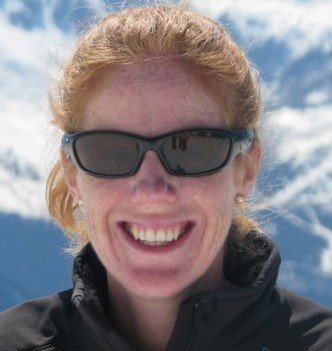
Wendy Briggs is a Lecturer in Initial Teacher Education and BA (Hons) Early Years Course Lead at the University of South Wales. With more than 30 years of experience across international and UK education, her research focuses on children’s belonging, curriculum innovation, place-based pedagogy, and the concept of cynefin within the Curriculum for Wales. Her work explores how child-centred pedagogies can create meaningful opportunities for participation, identity formation and democratic engagement. She is passionate about research and the translation of research into practice, ensuring that evidence informs both her own professional development and the practice of others
Sharon Phillips is a Lecturer in Initial Teacher Education on the University of South Wales with over 30 years of teaching experience in the primary sector. Her research spans an exploration of therapeutic interventions in schools and their impact on pupil wellbeing and behaviours; language acquisition and pedagogy, in particular implementing effective teaching of oracy and developing talk in the classroom, and development of the Welsh language and outdoor education; and an exploration of the perception of student teachers about their teacher identity and the concept of cynefin. She has a passion for research and how the research informs not only her own practice but that of others.
Connect with Sharon Phillips on LinkedIn.
This contribution is one of a series of short blog posts by presenters who will be sharing their work at the upcoming annual conference in Funchal, Madeira. Any views expressed in this post are those of the author(s) and do not necessarily reflect the official stance of their affiliated institution or EECERA.