
Participation in practice: Exploring how very young children experience their participation rights in ECEC settings in Wales
Posted 17th August 2026
Guest post by Lauren Henderson
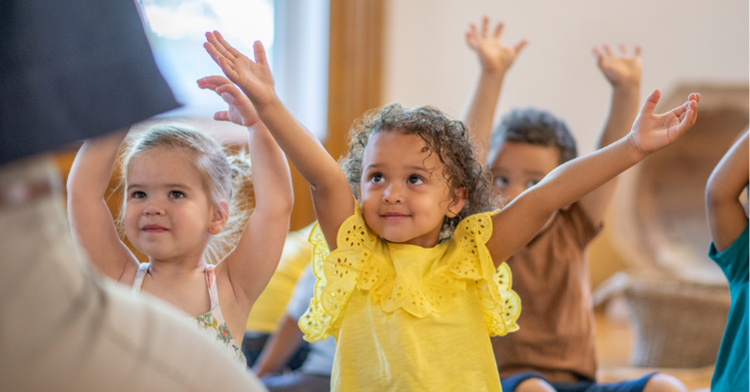
While participation rights apply equally to infants and young children (United Nations 1989; CRC 2009), compared to school-aged children we know relatively little about how babies, toddlers, and young children experience those rights in practice.
It was this gap that motivated my doctoral research exploring how children aged 0-5 experience their participation rights within early childhood education and care (ECEC) settings in Wales.
More specifically, I asked: if participation rights apply from birth, how are these rights experienced and realised within the everyday lives of babies, toddlers, and young children?
Recognising Young Children’s Views
The idea of the hundred languages of children reminds us that children communicate and make meaning through a wide range of symbolic, embodied, creative, and relational modes, not solely through speech (Edwards, Gandini and Forman 2011). Young children’s perspectives may be expressed through gesture, movement, emotional expression, play, persistence, negotiation, and refusal, although different forms of expression become more or less prominent across infancy and early childhood (Flewitt 2005; Clark 2017; Degotardi and Han 2020).
In everyday practice this might include an infant repeatedly reaching towards a desired object, a toddler seeking an adult’s attention, or a young child refusing to leave a valued activity. These moments may appear ordinary, yet they can also represent attempts to communicate preferences, negotiate experiences, and influence what happens around them.
The challenge, therefore, is not whether young children have perspectives to share, but whether those perspectives are recognised as meaningful contributions to everyday interactions and decisions.
Exploring Participation in Everyday Practice
To explore the ways in which young children experience their participation rights, I conducted a qualitative study across three Welsh ECEC settings involving 66 children aged between 12 months and 4 years 9 months, alongside 27 practitioners. Observations, practitioner interviews, child-centred activities, and video-elicitation interviews enabled exploration of how participation rights were understood, enacted, and experienced in everyday practice. The research was guided by the EECERA Ethical Code for Early Childhood Researchers (Bertram et al., 2025), with engagement in the research understood as an ongoing and relational process.
What Emerged?
Across the three settings, participation was experienced as far more than an opportunity to express views.
Children consistently associated participation with being listened to, taken seriously, and having some influence over what happened around them. Listening was not understood simply as adults hearing children’s words. Rather, it was understood through adults’ responses.
As one child explained:
“Like… when you talk and they do it.”
Children also attached strong emotional significance to these experiences. Being listened to was associated with kindness, happiness, and feeling valued. Conversely, when attempts to influence events were ignored or overridden, children often responded with frustration, withdrawal, or by seeking support elsewhere.
The findings challenged portrayals of young children as passive recipients of participation opportunities. Even very young children actively adapted how, when, and with whom they sought influence.
Importantly, practitioners across all three settings strongly valued children’s participation rights. However, children’s opportunities for influence were shaped not only by practitioners’ intentions, but also by wider organisational conditions, including routines, staffing pressures, time, and flexibility.
These findings led me to draw on the Capability Approach (Sen, 1999). From this perspective, participation is not simply about whether opportunities exist, but whether children are able to convert those opportunities into meaningful influence within their everyday lives.
Rather than asking whether children have participation rights, a capability perspective encourages us to ask:
Under what conditions are children able to realise those rights in ways that are meaningful to them?
Join the conversation
At EECERA 2026, I will discuss these findings in greater depth during my presentation, Exploring Young Children’s (Aged 0-5) Participation Rights in Early Years Settings in Wales, and explore their implications for children’s rights and participation.
Ultimately, participation is not realised simply because the right exists. Understanding participation as a lived capability encourages us to move beyond asking whether formal participation opportunities are available and instead consider the everyday conditions that enable babies, toddlers, and young children to translate their expressions, preferences, and perspectives into meaningful influence.
If you’re interested in this, you may also like:
Aksoy Kumru, F. B. (2024). Exploring children’s participation from Froebelian practitioners’ perspectives in Scottish context. European Early Childhood Education Research Journal, 32(4), 621–639. https://doi.org/10.1080/1350293X.2023.2301584.
Castro-Zubizarreta, A., & Sanz-Ponce, R. (2026). Exploring teachers’ understandings of implementing child participation in early childhood education in Spain. European Early Childhood Education Research Journal, 1–17. https://doi.org/10.1080/1350293X.2026.2705502.
References
Bertram, Tony, Chris Pascal, Helen Lyndon, Julia Formosinho, Donna Gaywood, Colette Gray, Jennifer Koutoulas, Eleni Loizou, Michel Vandenbroeck, and Margy Whalley. 2025. “EECERA Ethical Code for Early Childhood Researchers.” European Early Childhood Education Research Journal 33 (1): 4–18. https://doi.org/10.1080/1350293X.2024.2445361.
Clark, Alison. 2017. Listening to Young Children: A Guide to Understanding and Using the Mosaic Approach. 3rd ed. London: Jessica Kingsley Publishers.
Committee on the Rights of the Child. 2009. General Comment No. 12 (2009): The Right of the Child to Be Heard. CRC/C/GC/12. Geneva: United Nations. https://www.ohchr.org/en/treaty-bodies/crc/general-comments.
Correia, Nádia, Cláudia Camilo, Cecília Aguiar, and Fausto Amaro. 2019. “Children’s Right to Participate in Early Childhood Education Settings: A Systematic Review.” Children and Youth Services Review 100: 76–88. https://doi.org/10.1016/j.childyouth.2019.02.031.
Degotardi, Sheila, and Feifei Han. 2020. “Quality of Educator-Infant Conversational Interactions among Infants Experiencing Varying Quantity of Linguistic Input.” European Early Childhood Education Research Journal 28 (5): 743–57. https://doi.org/10.1080/1350293X.2020.1817245.
Edwards, Carolyn, Lella Gandini, and George Forman, eds. 2011. The Hundred Languages of Children: The Reggio Emilia Experience in Transformation. 3rd ed. Santa Barbara, CA: Praeger.
Flewitt, Rosie. 2005. “Is Every Child’s Voice Heard? Researching the Different Ways 3-Year-Old Children Communicate and Make Meaning at Home and in a Pre-School Playgroup.” Early Years 25 (3): 207–22. https://doi.org/10.1080/09575140500251558.
Sen, Amartya. 1999. Development as Freedom. Oxford: Oxford University Press.
United Nations. 1989. Convention on the Rights of the Child. UN General Assembly Resolution 44/25. New York: United Nations. https://www.ohchr.org/en/instruments-mechanisms/instruments/convention-rights-child.
About the Author
Lauren Henderson is a PhD researcher at Swansea University. Focusing on young children’s (aged 0 to 5) participation rights in pedagogical practice within early childhood education and care (ECEC) settings in Wales. Her research explores how children’s voices are recognised and used to implement decision making processes during everyday practice within nursery settings. Prior to beginning her doctoral studies, Lauren worked as a primary school teacher for over 10 years across England and Wales, where she developed a strong interest in children’s rights and inclusive pedagogies.
Connect with Lauren on LinkedIn.
This contribution is one of a series of short blog posts by presenters who will be sharing their work at the upcoming annual conference in Funchal, Madeira. Any views expressed in this post are those of the author(s) and do not necessarily reflect the official stance of their affiliated institution or EECERA.