
The BeeConncted project: Playful Making as a Pathway to Children’s Literacies
Posted 21st July 2026
Guest post by Jasmiina Leskinen & Sini Kontkanen
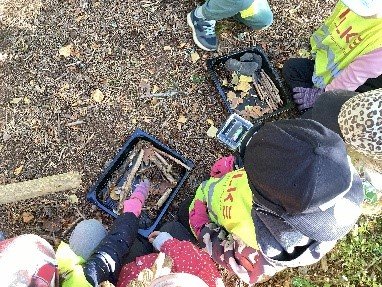
Figure 1. Children gathering natural materials from the forest to build huts for their Bee-Bots.
What happens when a small yellow robot meets pinecones, twigs, and childrens’ imagination? In our project BeeConnected, we set out to discover precisely this — how playful making with Bee-Bot robots and natural materials can nurture young children’s literacies?
Why Playful Making Matters
As digital technologies become increasingly woven into early childhood education and care, a pressing question emerges: how can we design learning environments where digital tools serve children’s imagination, storytelling, and relationships with the natural world?
Young children today grow up amid rapid digitalization and urgent socioecological challenges. Urban life can also distance them from meaningful encounters with nature (Edwards & Larson, 2020; Kumpulainen et al., 2023). At the same time, many children feel excluded from conversations about ecological issues and are rarely invited to share their experiences, concerns, and hopes about the environment (Piispa & Myllyniemi, 2019), particularly through child-centered means such as stories (Karlsson, 2013).
Drawing on maker pedagogy and sociocultural theory, our project explores how tinkering, the hands-on and iterative process of building and experimenting, can become a powerful site for both narrative and socioecological learning.
What We Did
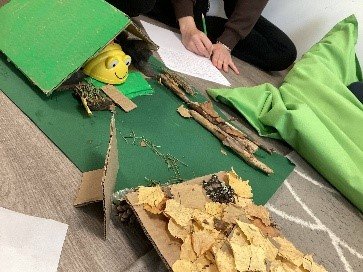
Figure 2. Storycrafting with Bee-Bots and artifacts.
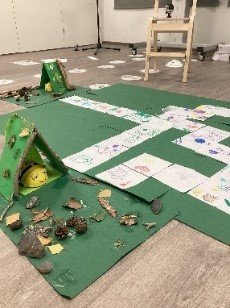
Figure 3. The collaboratively built village that hosted the children’s play and storycrafting.
The project took place at an ECEC center in eastern Finland, in autumn 2025. Twenty-one children aged 5–6, supported by one ECE teacher and two caregivers, designed and built huts and hideouts for Bee-Bot robots using natural materials. They also crafted paths for the robots and engaged with carefully selected stories woven into their design processes.
Our data include:
- video recordings (iPads and GoPros),
- photographs and ethnographic notes,
- children’s drawings and physical artefacts (the Bee-Bot huts),
- and children’s written stories.
We analysed these multimodal data using mediated discourse analysis (Scollon & Scollon, 2004), tracing how children moved fluidly between real and imagined worlds.
What We Found
Our analyses reveal two interconnected threads that we will share at EECERA 2026:
Story crafting through digital play. Building huts and paths for the Bee-Bots became a springboard for rich narrative settings. Children collaboratively constructed sequences, characters, and imagined worlds, casting the Bee-Bots in playful roles as story characters and companions. Story listening deepened these narratives, linking storytelling to purposeful, embodied action.
Cultivating socioecological care. Tinkering with natural materials invited children to attune to their Bee-Bots’ needs: petting and hugging them, building shelters, and storying caring roles for themselves. These relational practices, distributed across children, robots, and materials, fostered a form of socioecological literacy: a sensitivity to collective well-being among human and more-than-human entities (Jen, 2025).
Together, these findings show how playful making can simultaneously support narrative competence, digital literacy, and ecological care.
Join Us at EECERA 2026
We warmly invite you to our two presentations at EECERA 2026:
- Fostering Young Children’s Socioecological Literacy Through Tinkering with Bee-bots and Natural Materials
- Digital Play and Narrative Construction: Young Children’s Story Crafting with Bee-Bots
Selected References
Edwards, R. C., & Larson, B. M. H. (2020). When screens replace backyards. Environmental Education Research, 26(7), 950–968. https://doi.org/10.1080/13504622.2020.1776844
Jen, T. (2025). Cultivating Socioecological Care Through a Speculative Approach to Science Education. ICLS 2025 Proceedings, 763–771. https://repository.isls.org//handle/1/11803
Karlsson, L. (2013). Storycrafting method – To share, participate, tell and listen in practice and research. The European Journal of Social & Behavioural Sciences, 6(3), 1109–1117. https://doi.org/10.15405/ejsbs.88
Kumpulainen, K., Wong, C. C., Byman, J., Renlund, J., & Vadeboncoeur, J. A. (2023). Fostering children’s ecological imagination with augmented storying. The Journal of Environmental Education, 54(1), 33–45. https://doi.org/10.1080/00958964.2022.2152407
Piispa, M., & Myllyniemi, S. (2019). Nuoret ja ilmastonmuutos: Tiedot, huoli ja toiminta Nuorisobarometrien valossa [Young people and climate change: Knowledge, concern, and action in light of the Youth Barometers]. Yhteiskuntapolitiikka, 84(1), 61–69. https://www.julkari.fi/handle/10024/137610
Scollon, R., & Scollon, S. W. (2004). Nexus analysis: Discourse and the emerging internet. Routledge.

Jasmiina Leskinen is a postdoctoral researcher at the University of Eastern Finland. Her research explores STEAM learning, maker pedagogy, multimodal and collective learning through a sociocultural lens.

Sini Kontkanen is a university lecturer at the University of Eastern Finland. Her research focuses on how digital tools enhance teaching and learning, especially for young learners, and how authentic ICT experiences strengthen teachers’ readiness to use technology in education.
This contribution is one of a series of short blog posts by presenters who will be sharing their work at the upcoming annual conference in Funchal, Madeira. Any views expressed in this post are those of the author(s) and do not necessarily reflect the official stance of their affiliated institution or EECERA.