
Why nature matters for social-emotional learning in early childhood education in a digital age
Posted 22nd August 2026
Guest post by Jie Gao, Ziyi Wan, Junqing Zhai
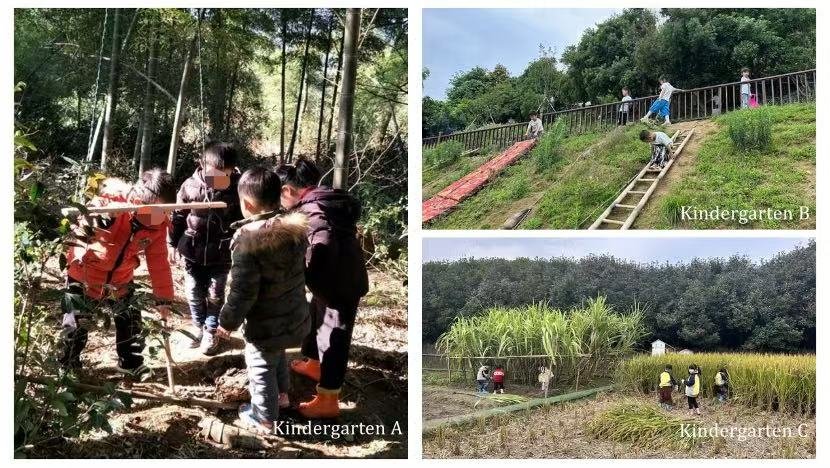
Children’s social-emotional learning (SEL) has long been a central concern of early childhood education worldwide. Yet, in an increasingly digital age, discussions of SEL often remain confined to classrooms, focusing on structured interventions, emotional literacy programmes, and behaviour-management strategies. This risks overlooking an important dimension of children’s development: their direct, physical relationship with the natural world. We invite colleagues to step outside and consider a different question: What happens when children’s emotional lives unfold in interaction with nature?
Our presentation at EECERA 2026 is based on a qualitative study with 24 ECE teachers from three public kindergartens in Hangzhou, China. Through in-depth interviews, we explored how teachers understand children’s social-emotional development outdoors when engaging with nature.
What emerged most powerfully was the language teachers used to describe their observation and practice. One teacher described her role as “listening to the wind, touching the soil, and watching the children”. Another described a child who greeted the same tree each morning and affectionately called it “Grandpa Tree”. These were not simply poetic expressions. They reflected a fundamentally different understanding of SEL, one in which emotions are not treated as isolated competencies, but as experiences that emerge through relationships with people, places, and the more-than-human world.
Nature as a co-educator
In our presentation, we will demonstrate how ECE teachers regard nature as a co-educator. Teachers reported observing children calming themselves by sitting under trees, expressing frustration through physical movement, and developing empathy while caring for plants, insects, or farm animals. Interestingly, teachers rarely described emotions as something taught through direct instruction. Instead, they saw SEL emerging through shared encounters and responsibilities: helping a peer carry bamboo poles, rebuilding a collapsed mud structure together, or noticing that another child had fallen behind during a walk. These examples suggest that outdoor environments can create distinctive conditions for co-regulation, perspective-taking, and mutual care.
Rethinking dominant SEL frameworks
These findings speak to wider debates about the cultural and theoretical foundations of SEL. Frameworks such as CASEL have had substantial international influence, but they can also encourage a view of social-emotional competencies as universal, measurable skills that can be taught and assessed in similar ways across contexts. The teachers in this study offered a different perspective. Their accounts aligned more closely with relational and ecological understandings of development, in which emotions emerge through interactions among children, adults, materials, places, and the more-than-human world. We argue that nature-based experiences may reveal dimensions of SEL that are often overlooked when learning is conceptualised primarily in cognitive or individual terms.
The Chinese context and global tensions
The Chinese context makes these issues particularly interesting. Chinese national curriculum guidance recognises social-emotional development as an important area of learning, yet teachers often work within systems where academic achievement, behavioural conformity, and risk avoidance remain powerful priorities. Many participants described tensions between the open-ended possibilities of outdoor play and parental expectations for visible academic outcomes. Some reported reframing nature activities as “hands-on skill development” in order to secure parental support, even when their primary intention was to nurture children’s wellbeing, confidence, and relationships.
We suspect these tensions will resonate with educators far beyond China. Across many countries, ECE practitioners are increasingly expected to support children’s wellbeing, resilience, and emotional regulation, while often receiving limited professional language, training, or institutional support for this work. This sense of professional uncertainty and the agency with which teachers respond to it, is something we hope to explore collectively during the presentation.
Why this matters now
Our presentation also connects to our broader research which uses participatory and multimodal methodologies to explore children’s perspectives on climate change and sustainability education. In an era marked by rapid digitalisation, environmental crises, and growing concerns about children’s wellbeing, we believe it is timely to ask how educational environments, whether natural, digital, or community-based, shape children’s opportunities to express emotions, build relationships, and participate meaningfully in the world around them.
We hope the presentation will encourage colleagues to reconsider what counts as SEL, where it happens, and whose knowledge is recognised in understanding children’s emotional development. Sometimes the most significant moments of social-emotional learning are not found in a planned lesson, but in a child quietly sitting beside a tree, digging in the soil, or calling a friend back to join the play. More information of the study can be seen here: Zhai, J., Wan, Z., & Gao, J. (2026). “Listening to the wind, watching the children”: Chinese teachers’ perspectives on social-emotional learning in nature-based early childhood education. Teachers and Teaching. Advance online publication. https://doi.org/10.1080/13540602.2026.2711892
If you’re interested in this, you may also like:
Smedsrud, T. M., Lenes, R., & Moser, T. (2026). Balancing engagement in children’s nature play: insights from Norwegian ECEC teachers. European Early Childhood Education Research Journal, 1–17. https://doi.org/10.1080/1350293X.2026.2661987.
Hattingh, L. (2024). Time to play, time to think: meaningful moments in the forest. European Early Childhood Education Research Journal, 32(1), 22–33. https://doi.org/10.1080/1350293X.2023.2221419.
About the Authors

Dr Jie Gao is an Associate Professor in Education at UCL Institute of Education. Profile page: https://profiles.ucl.ac.uk/74644-jie-gao; Connect with Dr Gao on Linkedin.
Ziyi Wan is a Master’s student in Comparative Education at the College of Education, Zhejiang University. Her research focuses on international and comparative education, with a specific interest in education for sustainable development (ESD) and nature-based early childhood education.


Dr. Junqing Zhai is an Associate Professor at the College of Education, Zhejiang University, and an Honorary Associate Professor at the University of Nottingham. He received his PhD from King’s College London. His research focuses on science and environmental education, informal science learning, and nature-based early childhood education, with work spanning teacher education, sustainability, and child–nature relationships.
This contribution is one of a series of short blog posts by presenters who will be sharing their work at the upcoming annual conference in Funchal, Madeira. Any views expressed in this post are those of the author(s) and do not necessarily reflect the official stance of their affiliated institution or EECERA.