
Why Thinking Together Matters More Than Ever
Posted 9th August 2026
Guest post by Debi Keyte-Hartland
Over the past two decades, I have had the privilege of working alongside educators in nurseries, schools, and international settings as a pedagogical coach-mentor. Across these diverse contexts, I have noticed a recurring pattern. Meaningful pedagogical change rarely begins with a new framework, policy document, or instruction to do something different. Instead, it begins with conversation.
Not just any conversation, but one in which educators experience genuine attention. A conversation where listening is valued as much as speaking; where uncertainty is not viewed as a weakness but as the beginning of enquiry; and where the conditions are cultivated for time to think (Kline, 1999). These are the kind of professional learning encounters I have come to describe as participatory thinking spaces.
My presentation at this year’s EECERA conference, Cultivating Teacher Agency Through Participatory Thinking Spaces: Pedagogical Mediation and Democratic Praxis in the Digital Age, grows from these experiences. It explores how collaborative and collective professional learning can nurture teacher agency by creating democratic spaces for dialogue, creativity, and shared meaning-making. At a time when many early childhood educators are navigating increasing accountability, digital data systems, and cultures of performativity, I believe these spaces have never been more important.
SPACE to Flourish is a professional learning programme for early years educators, aimed at fostering creative pedagogies through an attuned approach to teaching which focuses on nurturing the generative conditions to foster creative, playful environments where children and their educators both thrive and flourish (Keyte-Hartland and Gunning, 2026). The project has been funded by The Mercers’ Company and has been co-designed and developed with Early Education (2024).
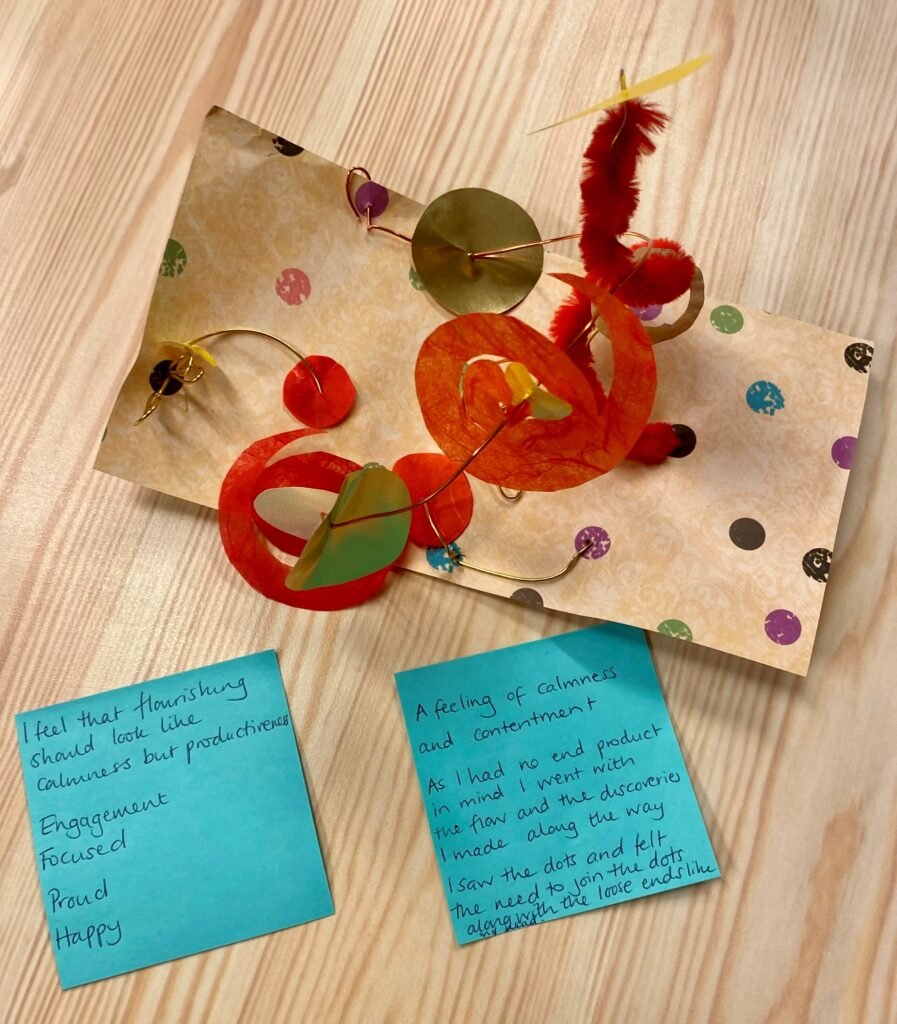
A collage made by an educator in one of the professional learning days. The collage represents to its maker their meaning of what flourishing means to them and how it felt to think-with and through the available collage materials.
“I feel that flourishing should look like calmness but productiveness. Engagement, focus, proud, happy.”
“A feeling of calmness and contentment as I had no end product in mind. I went with the flow and the discoveries I made along the way. I saw the dots and felt the need to join the dots along with the loose ends like my head.”
Like many colleagues working in early childhood education, I have become increasingly concerned about what happens when professional learning becomes dominated by mechanistic systems, compliance, efficiency, and measurable outcomes. While evidence-informed research is essential, there is a danger that the richness of pedagogy becomes reduced to checklists, targets, and technical competence. In these conditions, educators can begin to feel that their professional judgement and thinking related to their lived experience in early years carry less value than external expectations.
Ball (2003) describes this as a culture of performativity, where educators become increasingly judged through measurable outputs rather than thoughtful professional judgement. Peter Moss (2014) similarly argues that early childhood education risks becoming overly technocratic, losing sight of its democratic and ethical purposes. Rather than simply critiquing these pressures, my research asks a more hopeful question: How might we create the conditions in which educators can reclaim their professional agency through collective thinking?
This question has shaped both my pedagogical coaching practice and my research. Rather than viewing professional learning as something instructed and delivered by an expert to practitioners, I have become increasingly interested in approaches that position educators as co-researchers of their own practice. Here, pedagogical coaching becomes less about providing answers and more about creating the conditions for thinking in which new questions can emerge.
My research draws upon the traditions of pedagogical mediation (Formosinho, 2016; Lyndon et al., 2019), reciprocal formazione (Giamminuti, 2024) and Kline’s (1999) Thinking Environment. Although these perspectives emerge from different traditions, they share an important connection: people think better when they think together in environments characterised by attention, equality, appreciation and trust, and that learning is relational rather than transactional.
These ideas resonate deeply with the democratic philosophy that underpins the municipal infant-toddler centres and preschools of Reggio Emilia. Loris Malaguzzi’s vision is that education is fundamentally a political and ethical project rooted in relationships, participation and the hundred languages through which children and adults construct meaning together (Edwards, Gandini and Forman, 2012).
I have found myself increasingly drawn towards systems thinking and post-qualitative perspectives, particularly the work of Bateson (1972), Barad (2007), and Manning (2016). Although their ideas initially appeared abstract, they have profoundly influenced the way I understand professional learning. Bateson (1972) encouraged me to pay attention to the differences that occur that make the difference in practice, which are those subtle shifts in perception that fundamentally alter how we understand a situation. In my own work with educators, these moments of difference rarely arrived dramatically. They emerged through small and ordinary stories and moments, lingering conversations, playful and artful engagement with materials, examining photographs, or discussing snippets of children’s dialogue overheard or written down. When shared, these small moments and stories made visible and enabled conversation which explored what was noticed about the impact of teaching on children’s experiences with fresh eyes.
Transformation of practice often began quietly.
I was also drawn to Barad’s (2007) concept of agential realism, which challenges the assumption that knowledge belongs solely to human minds. Instead, meaning emerges through our entanglements with people, materials, spaces, and relationships. This perspective has encouraged me to see pedagogical documentation and artful engagement with materials as not simply either as a record of children’s learning or an instructional teaching strategy to replicate, but as active participants in professional transformation and becoming. The photographs we take, the artefacts that both educators and children create, the words spoken, the materials themselves are all companions in thinking together in which we are always re-forming, never fixed or static.
Similarly, Manning’s (2016) writing on artfulness, movement, and emergence reminded me that learning is always in the making and becoming. Professional learning, therefore, should not seek certainty or closure too quickly. Instead, participatory thinking spaces should invite educators to remain open to experimentation, creativity, and the possibilities that emerge through collective enquiry.
Methodologically, my work and study sit within a post-qualitative and performative paradigm (Østern et al., 2023). Rather than seeking fixed conclusions or universal truths, it embraced research as an evolving, relational, and creative process. Collage, storying, and pedagogical documentation were not simply methods for gathering data; they were ways of thinking. They enabled participants to explore their ideas and their practice and teaching through multiple symbolic languages, making visible aspects of their experience that perhaps conventional research approaches might sometimes overlook.
This has also prompted me to reconsider the role of pedagogical documentation itself. Too often, documentation has become associated with accountability or assessment. In this research, documentation was reclaimed as a democratic and lived practice (Rinaldi, 2006) that invited educators to reflect and interpret together, negotiate meanings, whilst remaining open to multiple possibilities.
Perhaps one of the most significant insights emerging from the research for me is that teacher agency was relational. It emerged through participation as a learning community, in dialogue with each other and through materials, which developed into collective enquiry and experimentation. Educators became more agentic when they experienced themselves as trusted contributors to shared pedagogical thinking. And this feels increasingly important within today’s digital landscape.
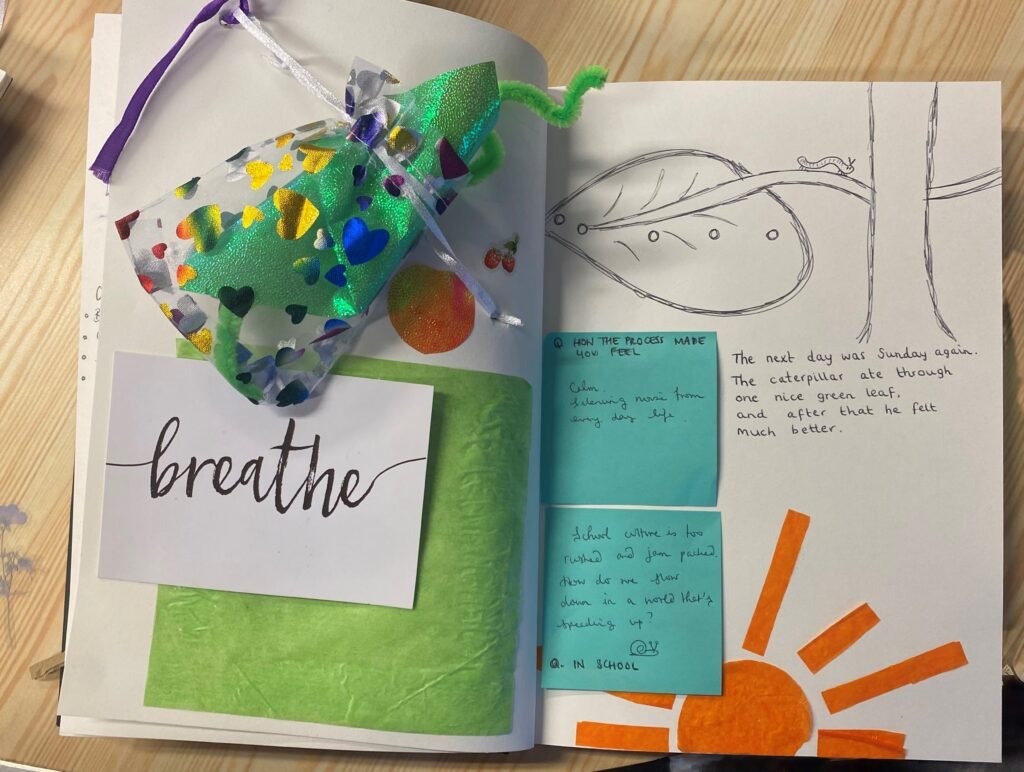
A collage made by an educator in one of the professional learning days.
“How does the process make me feel? Calm…”
“School culture is too rushed and jam packed. How do we slowdown in a world that’s speeding up?”
Digital technologies undoubtedly offer valuable opportunities for communication, documentation, and collaboration; yet they can also accelerate the pace of educational life, encouraging quick or standardised responses, measurable outputs, and constant visibility. Rosa (2019) reminded me that acceleration of educational life often diminishes our capacity for resonance and for those moments when we are genuinely moved, affected, and transformed through our encounters with the world and each other in contexts of professional learning.
Participatory thinking spaces enabled within the SPACE to Flourish project deliberately resisted this acceleration. They cultivated a kind of reflective slowness, a relational depth, and rich democratic dialogue. They protected time for sustained conversation, recognising that some of the most significant professional learning depended upon relationships, attentiveness to context, and trust in participants own capacity to think and develop their practice themselves.
Ultimately, this research was about hope and flourishing.
It was about believing that educators flourish when they are trusted to think deeply together. It was about recognising professional learning as a hopeful and democratic endeavour rather than a technical, fixing and mechanistic exercise. That it was about creating cultures where creativity, uncertainty, and ethical dialogue were valued as essential conditions for pedagogical growth. Instead of asking what are we proving here with this project – either about children’s learning or the educators – I began to ask instead, what is this entangled encounter inviting me to notice and what new questions does it raise? In doing so, I noticed that the quality of children’s learning experiences was inseparable from the quality of educators’ learning experiences and opportunities to think, reflect, create and imagine together. If we want our children to experience early childhood settings as places of democracy, creativity, participation, and belonging (Biesta, 2013), then our professional learning approaches must embody these same values. There is a mutuality between the two.
As I prepare to share my interim findings of SPACE to Flourish with colleagues at EECERA, I am reminded that conferences themselves can become participatory thinking spaces and be places where ideas meet, in which perspectives shift and new possibilities begin to emerge. It makes me now want to notice what resonates, moves, affects, and becomes transformed in participatory thinking spaces at EECERA and what new possibilities for children, educators, and democratic educational practice might emerge when we think together? I hope this blog and my presentation spark those conversations and noticing’s and contribute to a shared endeavour of nurturing early childhood education as a creative, relational, and deeply democratic practice within our digital age.
If you’re interested in this, you may also like:
Sønsthagen, A. G., Eggum, E., Pedersen, L., & Skoglund, R. I. (2026). Moving beyond collaboration to co-creation with families in early childcare institutions – a study of workshops with parents and staff. European Early Childhood Education Research Journal, 1–15. https://doi.org/10.1080/1350293X.2026.2642205.
Carlsen, K., & Clark, A. (2022). Potentialities of pedagogical documentation as an intertwined research process with children and teachers in slow pedagogies. European Early Childhood Education Research Journal, 30(2), 200–212. https://doi.org/10.1080/1350293X.2022.2046838.
References
Ball, S. J. (2003). The teacher’s soul and the terrors of performativity. Journal of Education Policy, 18(2), 215–228.
Barad, K. (2007). Meeting the universe halfway: Quantum physics and the entanglement of matter and meaning. Duke University Press.
Bateson, G. (1972). Steps to an ecology of mind. University of Chicago Press.
Biesta, G. (2013). The beautiful risk of education. Routledge.
Early Education. (2024). Supporting Pedagogy, Arts and Creativity Everywhere (SPACE) to Flourish. Available at: early-education.org.uk/space-to-flourish (Accessed 13 July 2026).
Edwards, C., Gandini, L., & Forman, G. (Eds.). (2012). The hundred languages of children: The Reggio Emilia experience in transformation (3rd ed.). Praeger.
Formosinho, J. (2016). Pedagogy-in-participation: Childhood association educational perspective. Porto Editora.
Giamminuti, S., (2024). Reciprocal formazione in Reggio Emilia. In: Giamminuti, S., Cagliari, P., Giudici, C. and Strozzi, P. The role of the pedagogista in Reggio Emilia: Voices and ideas for a dialectic educational experience. London: Routledge, pp. 21–52.
Keyte-Hartland, D., & Gunning, C. (2026). SPACE to Flourish: Cultivating children’s creativity through supporting pedagogy in professional learning – interim findings. Impact Journal. Issue 27. Available from: https://my.chartered.college/impact_article/space-to-flourish-cultivating-childrens-creativity-through-supporting-pedagogy-in-professional-learning-interim-findings/ [Accessed 13 July 2026].
Kline, N. (1999). Time to think: Listening to ignite the human mind. Cassell.
Lyndon, H., Bertram, T., Brown, Z., & Pascal, C. (2019). Pedagogically mediated listening practices; the development of pedagogy through the development of trust. European Early Childhood Education Research Journal, 27(3), 360–370. https://doi.org/10.1080/1350293X.2019.1600806
Manning, E. (2016). The minor gesture. Duke University Press.
Moss, P. (2014). Transformative change and real utopias in early childhood education: A story of democracy, experimentation and potentiality. Routledge.
Østern, A.-L., Knudsen, K. N., Blikstad-Balas, M., & Watt, M. (2023). Postqualitative inquiry and the art of research. Routledge.
Rinaldi, C. (2006). In dialogue with Reggio Emilia: Listening, researching and learning. Routledge. Rosa, H. (2019). Resonance: A sociology of our relationship to the world (J. C. Wagner, Trans.). Polity Press

Debi Keyte-Hartland is an internationally respected early childhood consultant, speaker, author and pedagogical coach with over 30 years’ experience in education. Inspired by the educational philosophy of Reggio Emilia, Italy, her work explores how creativity, materials, dialogue and relationships enrich children’s learning and strengthen educators’ practice. Debi works with schools, nurseries and organisations across the UK and internationally, supporting curriculum development, pedagogical leadership and professional learning through collaborative enquiry. She also teaches on the MA Early Childhood programme at the Centre for Research in Early Childhood (CREC) and has contributed to research exploring children’s participation in schools across Wales. Widely recognised for her engaging keynotes and workshops, Debi is passionate about cultivating teacher agency and creating reflective spaces where educators reconnect with their values, embrace curiosity and develop inspiring, arts-rich learning experiences for young children.
This contribution is one of a series of short blog posts by presenters who will be sharing their work at the upcoming annual conference in Funchal, Madeira. Any views expressed in this post are those of the author(s) and do not necessarily reflect the official stance of their affiliated institution or EECERA.