
Beyond the screen: Rethinking children’s agency through light and shadow play
Posted 3rd July 2026
What a study in Mongolian kindergartens reveals about technology, participation, and democratic learning
Guest post by Tserennadmid Shagdarsuren and Tala
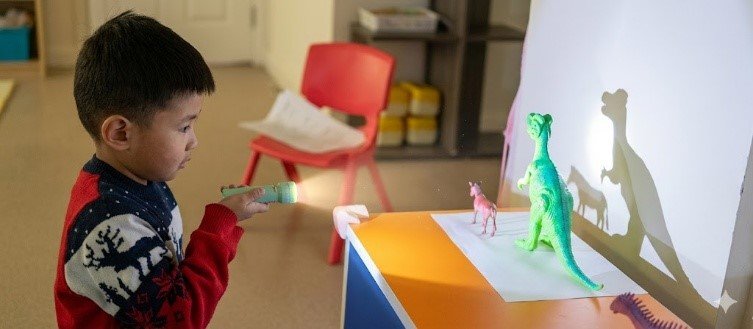
Fig. 1. A child explores light and shadow with toy animals.*
When we talk about children’s agency, we often imagine a child making an independent choice—selecting an activity, taking the lead. But what happens when a five-year-old moves a light closer to an object, watches the shadow grow, and calls others over to see? Or when a child looks at a hand shadow and declares, “This isn’t a rabbit—it’s a new animal”? These moments reveal something important: agency is not always an individual act. It often emerges through relationships—between children, educators, materials, and technologies.
This insight comes from a six-week study conducted in two public kindergartens in Ulaanbaatar, Mongolia, involving 38 five-year-old children. The study explored how children participated in hybrid light–shadow play using torches, projectors, and wearable light strips—and what these reveals about agency, inclusion, and technology in early childhood education.
Agency as a shared process
In one activity, a child discovered that moving a light source closer to an object enlarged the shadow. Others joined in immediately, experimenting with distance, movement, and positioning. What began as one child’s observation became a collaborative investigation—illustrating what the study calls relational agency: ideas that develop through observing, imitating, extending, and transforming one another’s actions. Agency is not only about independence; it is about participation, collaboration, and shared meaning-making.
Why light and shadow play matters
Light and shadow play invites uncertainty and imagination. During one storytelling activity, a projected shape sparked a group narrative:
“It’s a dragon flying over the city.”
“No, it’s a bird protecting us.”
“It changes at night.”
Rather than seeking a single correct answer, the children built a shared narrative through discussion and imagination—demonstrating how open-ended play supports creativity, communication, and democratic participation.
Technology as a catalyst, not a replacement
Debates about technology in early childhood education often ask whether digital tools support or hinder learning. The findings suggest a more useful question: how are technologies being used? In this study, projectors and wearable light strips enriched rather than replaced play—encouraging movement, storytelling, and collaborative performance. The educational value lay not in the technology itself, but in the open-ended, child-centered experiences it supported (Edwards, 2015; Bird & Edwards, 2015).
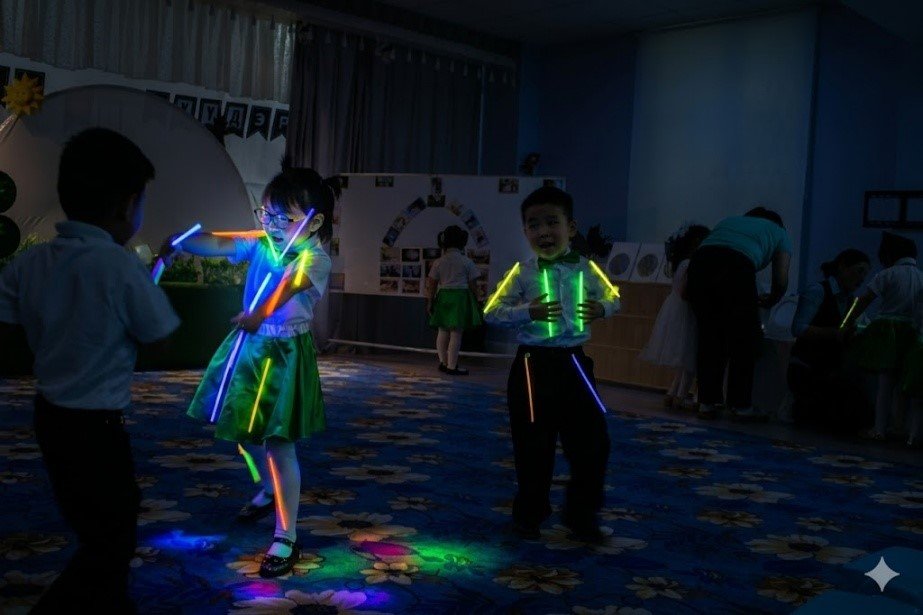
Fig. 2. Children engage in hybrid light play with wearable light strips.*
Participation takes many forms
One of the study’s most significant findings was that participation is not always verbal. One child rarely spoke but repeatedly adjusted objects to alter shadow shapes, subtly influencing the group’s play without a single word. If educators recognize only confident verbal expression as genuine participation, they risk overlooking children who contribute through gesture, movement, or quiet engagement. Meaningful participation exists along a continuum—and all points on that continuum deserve acknowledgement.
Why the Mongolian context matters globally
Mongolia’s early childhood sector is navigating a transition from teacher-directed traditions toward play-based and participatory approaches (UNICEF Mongolia, 2020). Despite large class sizes and limited resources, this study shows that meaningful innovation does not require expensive technologies. Post-socialist Central Asian contexts remain underrepresented in early childhood research, and evidence from Ulaanbaatar speaks directly to global conversations about equitable, contextually grounded digital integration.
A final thought
Light and shadow play reminds us that agency is not located solely within individual children—it emerges through relationships, interactions, and shared environments. In a digital age, children do not need technology that speaks for them. They need environments where technologies, materials, and educators help make their many forms of participation visible.
*The photographs used in the blog were taken during our research project in kindergartens. Written permission to use and publish these photographs was obtained from the participating kindergartens, the children’s parents or legal guardians, and the teachers involved in the study.
References
Bird, J., & Edwards, S. (2015). Children learning to use technologies through play: A digital play framework. British Journal of Educational Technology, 46(6), 1149–1160. https://doi.org/10.1111/bjet.12191
Edwards, S. (2015). Digital play in the early years: A contextual response to the problem of integrating technologies and play-based pedagogies in the early childhood curriculum. Early Years, 35(1), 4–17. https://doi.org/10.1080/09575146.2014.954296
Kumpulainen, K., Lipponen, L., Hilppö, J., & Mikkola, A. (2014). Building on the positive in children’s lives: A co-participatory study on the social construction of children’s sense of agency. International Journal of Early Childhood, 46(2), 213–228. https://doi.org/10.1007/s13158-014-0110-9
Marsh, J., Plowman, L., Yamada-Rice, D., Bishop, J. C., & Scott, F. (2018). Digital play: A new classification. Early Years, 39(4), 329–342. https://doi.org/10.1080/09575146.2018.1473368
Rinaldi, C. (2006). In dialogue with Reggio Emilia: Listening, researching and learning. Routledge.
UNICEF Mongolia. (2020). Early childhood care and development in Mongolia: Situation analysis. https://www.unicef.org/mongolia/reports/early-childhood-care-and-development
Vygotsky, L. S. (1978). Mind in society: The development of higher psychological processes. Harvard University Press.
Wood, E. (2014). Free choice and free play in early childhood education: Troubling the discourse. International Journal of Early Years Education, 22(1), 4–18. https://doi.org/10.1080/09669760.2013.830562
About the authors


Tserennadmid Shagdarsuren is a researcher at the Child Development Mentoring Center, Mongolia, and Tala is a doctoral student at the Mongolian National University of Education. Both focus on children’s agency, participatory pedagogy, and the integration of digital and physical play environments. This blog post draws on empirical research “Reconceptualizing Children’s Agency in Hybrid Light–Shadow Play: An Empirical Study in Mongolian Early Childhood Education” conducted in Kindergartens No. 63 and No. 42 in Ulaanbaatar.
See and connect with Tserennadmid Shagdarsuren: Research Gate, LinkedIn, Facebook.
Connect with Tala on Facebook.