
Rethinking Reflection in Early Childhood Education: Agency, Democracy and the Digital Age
Posted 23rd June 2026
Guest post by Debra Williams
Traditionally, reflection in Early Childhood Education has been positioned as an individual professional competency or a compliance requirement linked to quality assurance systems. However, this framing is increasingly insufficient in the context of digital documentation platforms and data-driven pedagogical environments.
This research explores how reflection is being reshaped by digital systems, accountability frameworks, and evolving understandings of professional practice. It argues that reflection should instead be understood as a relational, distributed, and socio-digital practice that is central to agency, participation, and democracy in Early Childhood Education.
Rather than occurring in isolation, reflection emerges through dialogue, collaboration, and shared interpretation among educators. It is also shaped by digital infrastructures that influence what is made visible, valued, and documented as professional knowledge.
This raises important questions:
- Who gets to define what counts as reflection?
- How do digital systems shape professional judgement?
- And how can we ensure that children’s and educators’ voices remain central in increasingly data-driven environments?
To address these questions, I introduce the SCHEMED framework, which conceptualises reflection as:
- Structured
- Collaborative
- Heart-centred
- Empowering
- Distributed
- Embedded
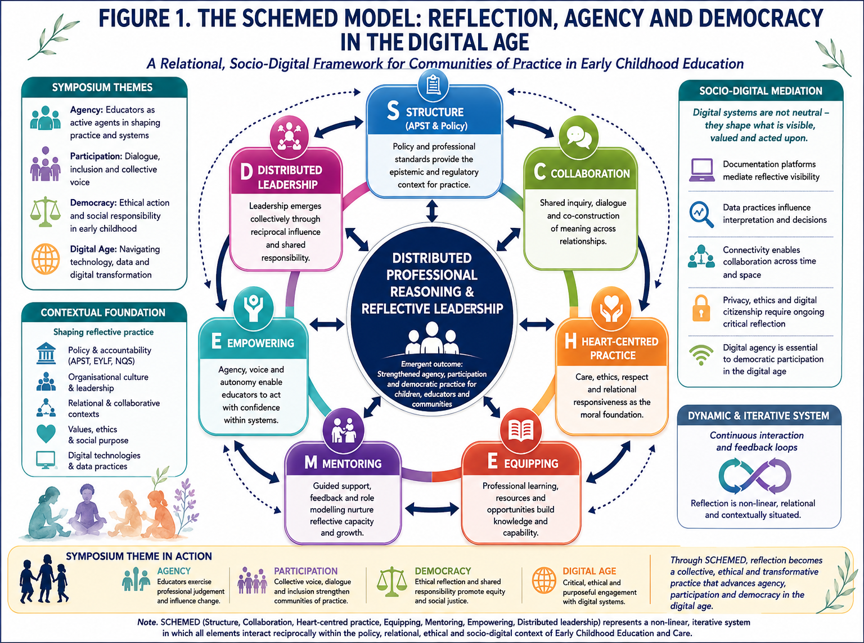
SCHEMED reframes reflection not as an isolated activity, but as a dynamic practice co-constructed through relationships, leadership, and digital systems.
This perspective has important implications for practice, policy, and research. It calls for a shift away from documentation-heavy compliance models towards more dialogic, relational, and democratic approaches to professional reflection.
In a digital age, the challenge is not whether we reflect, but how reflection is shaped, mediated, and shared — and whose voices are included in that process.
SCHEMED Reframes Reflection in Early Childhood Education
My upcoming EECERA 2026 presentation entitled “Leading an Early Childhood Community of Practice”, examines how reflection is no longer solely an individual or compliance-based activity, but a relational and socio-digital practice embedded within everyday professional interactions.
The research identified key tensions in the sector, including:
– Agency versus compliance
– Participation versus surveillance-driven systems
– Democracy versus accountability frameworks
Findings suggest that reflection is distributed across educators, leadership practices, and digital documentation systems, and is actively shaped by technological infrastructures that determine what is made visible as professional knowledge.
A key contribution of the presentation was the introduction of the SCHEMED framework, which conceptualises reflection as:
Structured, Collaborative, Heart-centred, Empowering, Distributed, and Embedded practice.
The framework positions reflection as a relational process co-constructed through professional dialogue, leadership engagement, and digital systems, rather than an isolated cognitive or administrative task.
The research calls for renewed attention to the ethical and democratic implications of digital documentation in EarlyChildhood Education, particularly in relation to agency, voice, and participation.
This work contributes to ongoing international debates on how early childhood systems can sustain relational pedagogy and democratic practice in the context of increasing digital transformation.
Further reading:
Charmaz, K. (2014). Constructing grounded theory (2nd ed.). Sage.
Dewey, J. (1933). How we think: A re-statement of the relation of reflective thinking in the education process. Henry Regnery.
Fook, J. (2015). Reflective practice and critical reflection. In J. Higgs et al. (Eds.), Practice-based education (pp. 440–454). Sense.
O’Connor, A., & Diggins, C. (2002). On reflection: reflective practice for early childhood educators. Open Mind Publishing.
Schön, D. A. (1983). The reflective practitioner: How professionals think in action. Basic Books.
Yin, R. K. (2018). Case study research and applications (6th ed.). Sage.

Debra Williams has worked in Early Childhood Education and Care in Australia for over four decades and is still as passionate as ever about this sector! She’s been engaged in both practice and academia and delights in engaging in opportunities to translate theory into practice and share knowledge and experience.
This contribution is one of a series of short blog posts by presenters who will be sharing their work at the upcoming annual conference in Funchal, Madeira. Any views expressed in this post are those of the author(s) and do not necessarily reflect the official stance of their affiliated institution or EECERA.