
Developed, not taught: Digital judgement, moral agency, and early childhood in the digital age
Posted 1st July 2026
Guest post by Gila Hammer Furnes
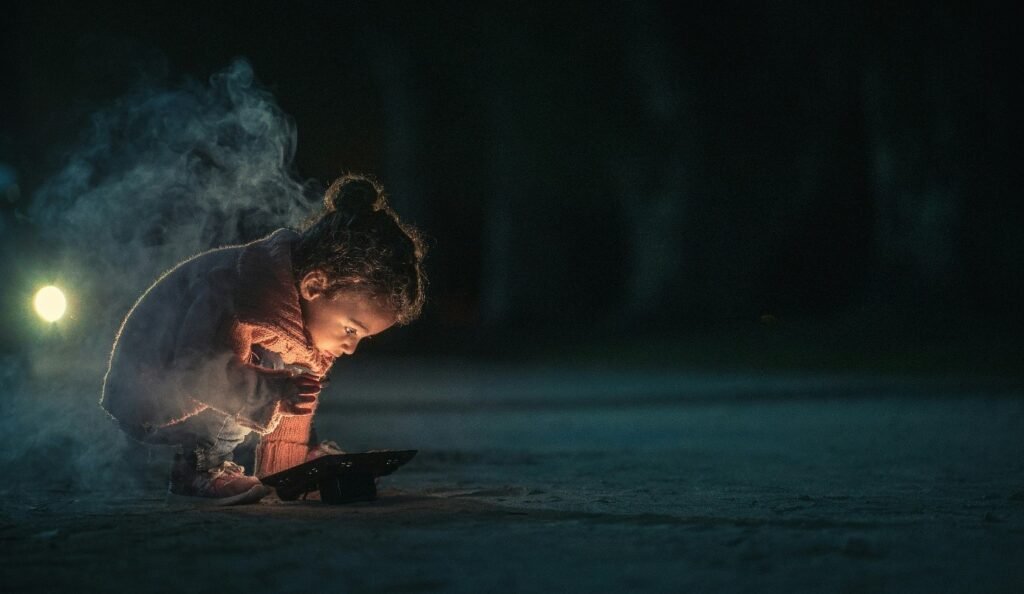
Photo by Gabriel Gonzalez on Unsplash
For many years, discussions about digital technologies in early childhood education focused primarily on access, use, and digital competence, while questions of ethics and judgement often remained in the background. Today, children are increasingly protected from digital technologies through restriction and control, while simultaneously expected to develop digital judgement. This blog explores what pedagogical responsibility looks like when digital judgement is understood not as a skill to be transmitted, but as something that emerges through children’s lived encounters with moral questions, relationships, and digital experiences.
Developed, Not Taught? Digital Judgement in Early Childhood
“If adults only knew what we see online.”
I have heard versions of this sentence many times when speaking with children about their digital lives. What stays with me is not only what children have seen, but how thoughtfully they often respond to it.
Their responses point to a paradox that lies at the centre of my upcoming EECERA 2026 presentation.
What if early care and education (ECEC) is so focused on teaching digital judgement that we fail to recognise the moral responsiveness and emerging judgement children are already demonstrating?
My interest in this question has emerged not only from research, but also from years of conversations with educators, leaders, and parents. Across numerous talks and workshops on children’s digital lives, digital judgement is repeatedly described as something children need to develop. This concern is also reflected in Norwegian early childhood policy, where digital judgement is presented as an important educational responsibility. Yet these conversations often leave a fundamental question unexplored: what do we actually mean when we say that young children should develop digital judgement, and how might such judgement emerge?
The paradox of protection and judgement
We increasingly seek to protect children from digital technologies through restriction, supervision, and control. At the same time, we expect them to develop digital judgement at an early age. We want children to make wise decisions online, recognise manipulation, act responsibly, and exercise good judgement. Yet this raises an important question: where does such judgement come from?
Research on children’s digital lives has understandably focused on protection, regulation, safety, and digital competence. These conversations are important. However, they often frame judgement as something that must be taught before children can exercise it. Increasingly, I find myself wondering whether this perspective overlooks something important.
Sometimes young children encounter disturbing content, exclusion, humiliation, or exploitation online. Increasingly, many of these encounters also take place in digital environments, where children face questions of truth, fairness, belonging, exclusion, and responsibility.
Often, what strikes me is not only what they have seen, but what they choose not to tell adults. Many children seem to have a keen sense of what adults can bear hearing and what they cannot.
A child may encounter something online that feels wrong without having the language to explain why or the concepts needed to analyse it. Nevertheless, they may pause, hesitate, or experience discomfort because they sense that something is not as it should be. These moments may appear small, but they matter because they reveal the beginnings of judgement.
Children as morally responsive subjects

In some of my recent work, I have explored children’s moral responsiveness in digital culture. I have written about the child who is not seen, even while surrounded by people who care about them. I have explored what it means to say “Here I am” for children and adults in a culture of digital noise. More recently, I have examined what happens when children turn to artificial intelligence (AI) with existential questions they cannot ask elsewhere, and discussed education’s role after the machine has answered.
Across these different inquiries, one question keeps returning: How do we respond in education when children are already responding to the world?
Children encounter moral questions long before adults introduce them in classrooms. They notice when someone is excluded, worry about friends, recognise unfairness, wonder whether something is kind, and ask whether something is true. In this sense, children are responding to the world long before they can fully explain their responses. Their responses may be incomplete, uncertain, or difficult to articulate, but they are responses, nonetheless.
If judgement is developed, not taught
My EECERA 2026 presentation develops this idea further. Rather than asking how digital judgement can be transmitted to children as a skill, I ask whether digital judgement develops through children’s lived encounters with moral questions and relationships.
Drawing on Lévinas, Biesta, and Lipman, I explore judgement not as a competency that can simply be delivered through instruction, but as something that emerges through lived inquiry, relational responsibility, and encounters with Others. From this perspective, judgement develops through lived moral experience, relationships, uncertainty, and encounters that invite reflection on fairness, responsibility, belonging, and care.
Implications for early childhood education
This does not mean that adults become less important. Quite the opposite. If children are already morally responsive, our responsibility may not begin with teaching judgement, but with recognising, sustaining, and accompanying its development. This involves creating spaces where children’s questions can be explored rather than prematurely answered.
At EECERA 2026, I will explore what this perspective might mean for early childhood education. If digital judgement develops through children’s lived encounters with people, relationships, and moral questions, then educational practice and policy may need to move beyond restriction and skills-based approaches alone.
If children are already morally responsive subjects, capable of responding to questions of fairness, care, belonging, and responsibility long before they can fully explain or justify those responses, what becomes the educational responsibility of early childhood education? If children are already morally responsive subjects, how might education recognise, sustain, and accompany the development of digital judgement without reducing it to a skill to be taught?
Further reading
This post is based on the following publications and EECERA 2026 conference abstract (Furnes, 2025, 2026a, 2026b, 2026c):
Furnes, G. H. (2025). What we almost said. On the lost conversations in the digital era. Childhood & Philosophy, 21, 1–19. https://doi.org/10.12957/childphilo.2025.92020
Furnes, G. H. (2026a, 25–28 August 2026). Developed, not taught: Digital judgement, moral agency, and early childhood in the digital age 34th EECERA Annual Conference: The Development of agency, Participation and Democracy in a Digital Age, Madeira-Tecnopolo, Portugal. https://eecera.org/eecera-2026/
Furnes, G. H. (2026b). “Here I Am”: Reclaiming moral presence in a culture of digital noise. Digital Culture & Education, 16(2). https://www.digitalcultureandeducation.com/volume-162
Furnes, G. H. (2026c). In the absence of response. Children, AI, and the ethics of attention. Ethics and Education, 1–16. https://doi.org/10.1080/17449642.2026.2646752
About the author

Gila Hammer Furnes is an Associate Professor in Education at NLA University College, Norway. Her research explores children’s moral and educational experiences in digital culture, with particular attention to digital judgement, ethical responsiveness, artificial intelligence, and childhood in a rapidly changing technological landscape. Drawing on philosophical and pedagogical traditions, her work examines how children encounter moral questions through everyday relationships, digital dilemmas, and emerging technologies. She is currently developing an ongoing programme of philosophical inquiry into childhood, digital culture, and ethics, including work on moral presence, children’s experiences of being seen and heard in digital environments, and the educational implications of children’s interactions with artificial intelligence. Her research seeks to contribute to discussions on how early childhood education can recognise and support children’s emerging judgement, agency, and ethical attentiveness in contemporary society.
This contribution is one of a series of short blog posts by presenters who will be sharing their work at the upcoming annual conference in Funchal, Madeira. Any views expressed in this post are those of the author(s) and do not necessarily reflect the official stance of their affiliated institution or EECERA.