
Parental involvement in German Early Childhood Education and Care: Opportunities Possibilities and Barriers
Posted 24th June 2026
Guest post by Prof. Dr. Armin Schneider

According to the German Law (not dissimilar to laws in other countries) parents are considered the main guardians of their own children. They are responsible for caring, educating and raising their children, instilling their own ideas, beliefs, rules, and attitudes.
Children’s and parents’ rights and the state’s supervisory role are often in conflict with one another.
According to the UN Convention on the Rights of the Child, the best interest of the child should always take priority and should always be the guiding principle, not only in early childhood institutions.
Parents play an important role within the family and in their direct personal contact with the kindergarten staff, they also have a significant role to play liaising with consultative bodies where the quality of kindergartens is concerned.
In some German federal states, parents can build parent committees with a lot of rights in the Kindergarten. They have to participate in the pedagogical concept, they take part in evaluations and in quality management systems, their voice must also be heard on issues such as staffing shortages or major changes. This voluntary work of estimated 400.000 parents is a great but under researched element of the Early Childhood Education and Care in Germany.
Our study with about 1.200 parents in Rhineland-Palatinate highlights opportunities and possibilities, but also obstacles to parental involvement. In this German federal state, a law established in 2021 dictates a parent committee as well as a day care advisory board (“Kita-Beirat”) have to be established. They consist of representatives of the management, the provider organization, educators, parents, as well as a specialist who is responsible for incorporating the children’s perspective into the work and making recommendations to the provider organization regarding key decisions.
Our research reveals that neither the parent meetings required by law nor the day care advisory boards are in place across the board, nor do they fully fulfil their statutory requirements. This is due to a variety of reasons; in some cases, it stems from a lack of knowledge and awareness of the legal obligations, in others, their value is not recognized.
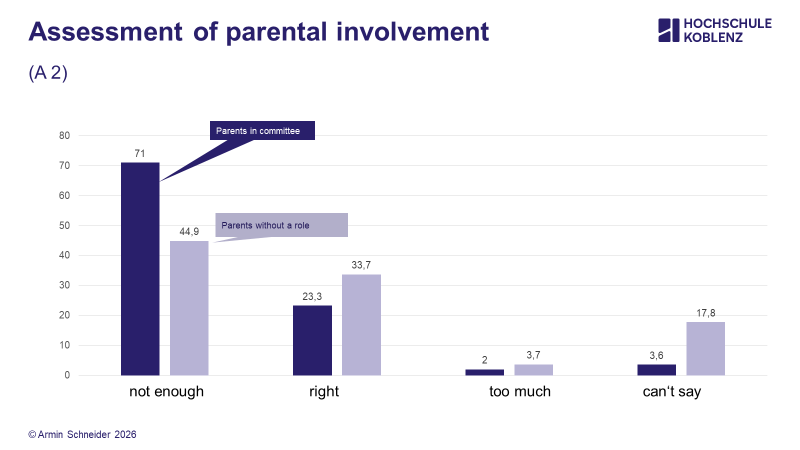
Engaged parents notice the lack of parental committees more than those less engaged. E.g. 71 percent of the engaged parents see the engagement of parents as “not enough” against 44,9 percent of the not engaged parents.
Some obstacles are created by the providers and the heads of the institutions who are not working in partnership with parents to make decisions. Other difficulties lay in the representation – parents with lower socio-economic status are often not represented and therefore the elections, and the framework of the committees (e.g. evening meetings, language barriers, preference for more eloquent speakers) only perpetuate existing inequalities between parents and families.
Only when all parents are given a voice, are supported and new forms of participation are established can the kindergarten as a whole fulfil its potential for children and their families.
Further reading
Link to the Study (in German): https://www.hs-koblenz.de/fileadmin/media/fb_sozialwissenschaften/IBEB/Aktuelles/2025/IBEB_Forschungsbericht_Elternmitwirkung_LEA_final_19.11.2025.pdf
European Commission (2024): Working Group on Early Childhood Education and Care (ECEC). Leadership in ECEC: an overview of models and practices in Europe. Brussels: European Commission.
Haryanto, Bakir/Faradiena Fayna/Rahayu, Budiarti/Yulindrasari,Hani/Purwono, Urip/Negara, Radi (2024): The impact of Child Learning Centres on parenting practices and early childhood development: Lessons from the Rumah Anak SIGAP Program 2021-2023. Tanoto Foundation. https://research.acer.edu.au/early_childhood_misc/36
OECD (2024): Engaging parents and guardians in early childhood education and care centres. Paris: OECD.
OECD (2025): Results from TALIS Starting Strong 2024: Strengthening Early Childhood Education and Care, TALIS, OECD Publishing, Paris, https://doi.org/10.1787/20af08c0-en.
Otero-Mayer, Andrea/Gonzále-Benito, Ana/Gutiérrez-de-Rozas, Belén/Expósito-Casas, Eva (2025): Family Ivolvment in Early Childhood Education: A Systematic Review of its Measurement. In: Early Childhood Educational Journal. https://doi.org/10.1007/s10643-025-02024-4.
Roth, Xenia (2022): Handbuch Zusammenarbeit mit Eltern. Freiburg im Breisgau: Herder Verlag.
Stronger Families Alliance (o.J.): Strengthening our villages. https://strongerfamilies.net.au/child-youth-familyplan/strengthening-our-villages/
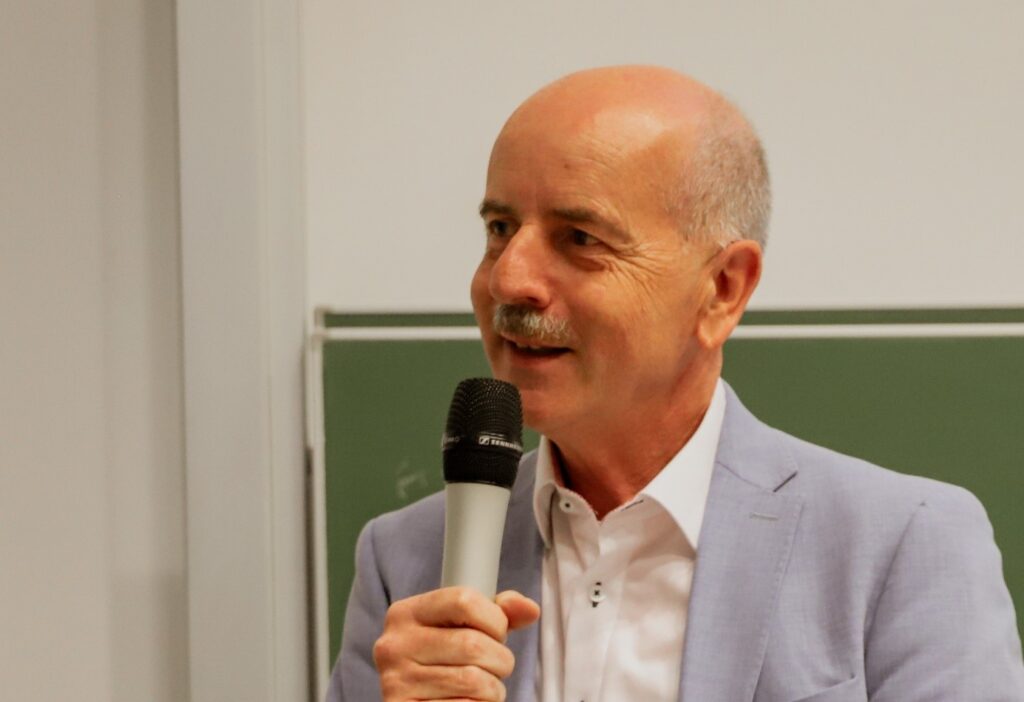
Prof. Dr. Armin Schneider is Director of the Institute for Education, Upraising and Child Care (IBEB) at the University of Applied Sciences, Koblenz, Germany.
This contribution is one of a series of short blog posts by presenters who will be sharing their work at the upcoming annual conference in Funchal, Madeira. Any views expressed in this post are those of the author(s) and do not necessarily reflect the official stance of their affiliated institution or EECERA.